

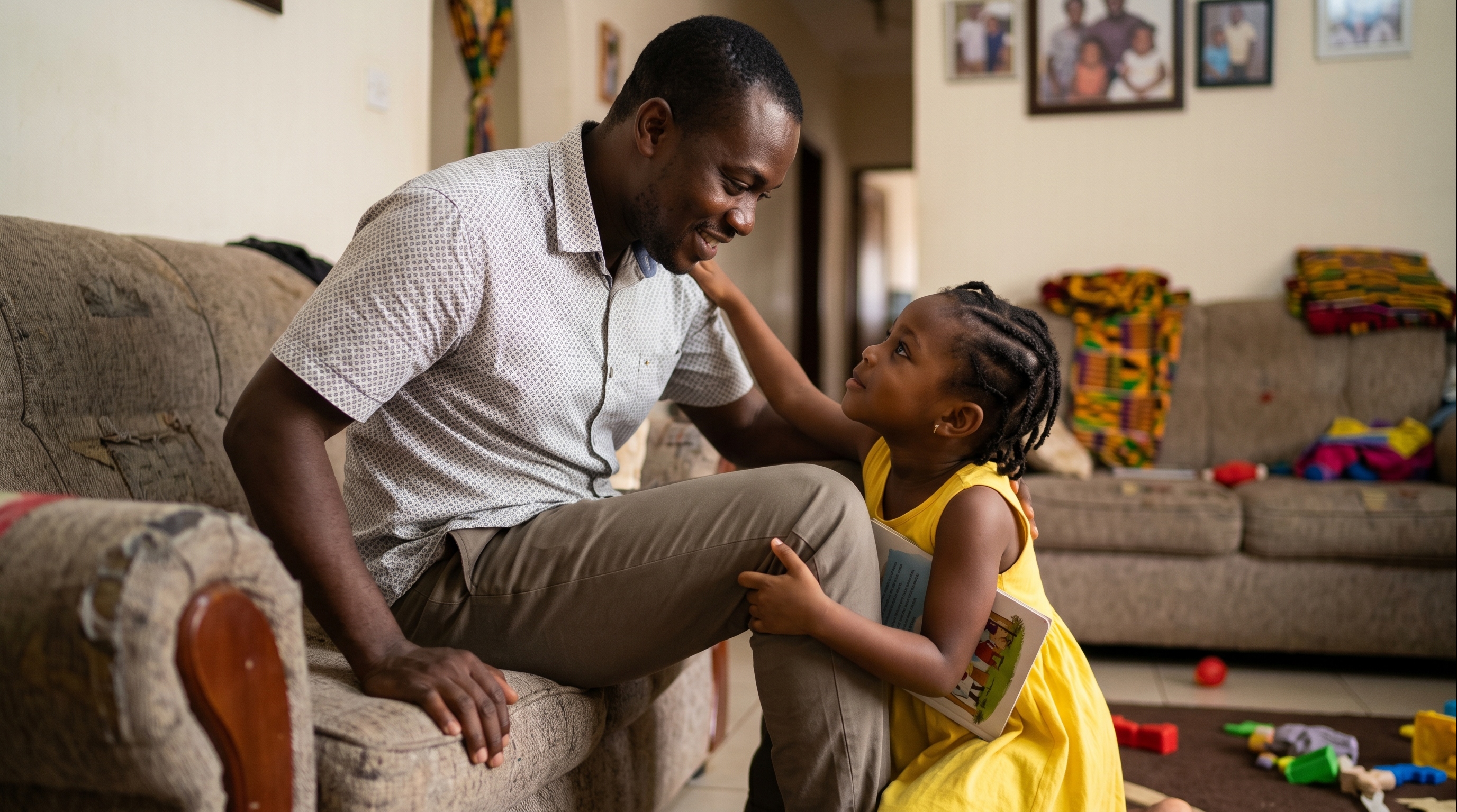
Kolade was the kind of man who believed that providing was the same as being present. He worked long hours at his logistics firm in Ibadan, came home with groceries sometimes, and paid school fees every time. He loved his children deeply, the way most African men have been taught to love: quietly, practically, through sacrifice. His eight-year-old son, Emeka, and his six-year-old daughter, Adaeze, never lacked for anything material.
And yet, something was always slightly off at the edges of his evenings — a tension he could feel but couldn't name, a distance that lived in the same house as all the provision.
It was a Thursday night in October when Kolade finally sat still long enough to notice. He had come home late again, loosened his tie, and settled into the sofa with his phone and the remnants of dinner.
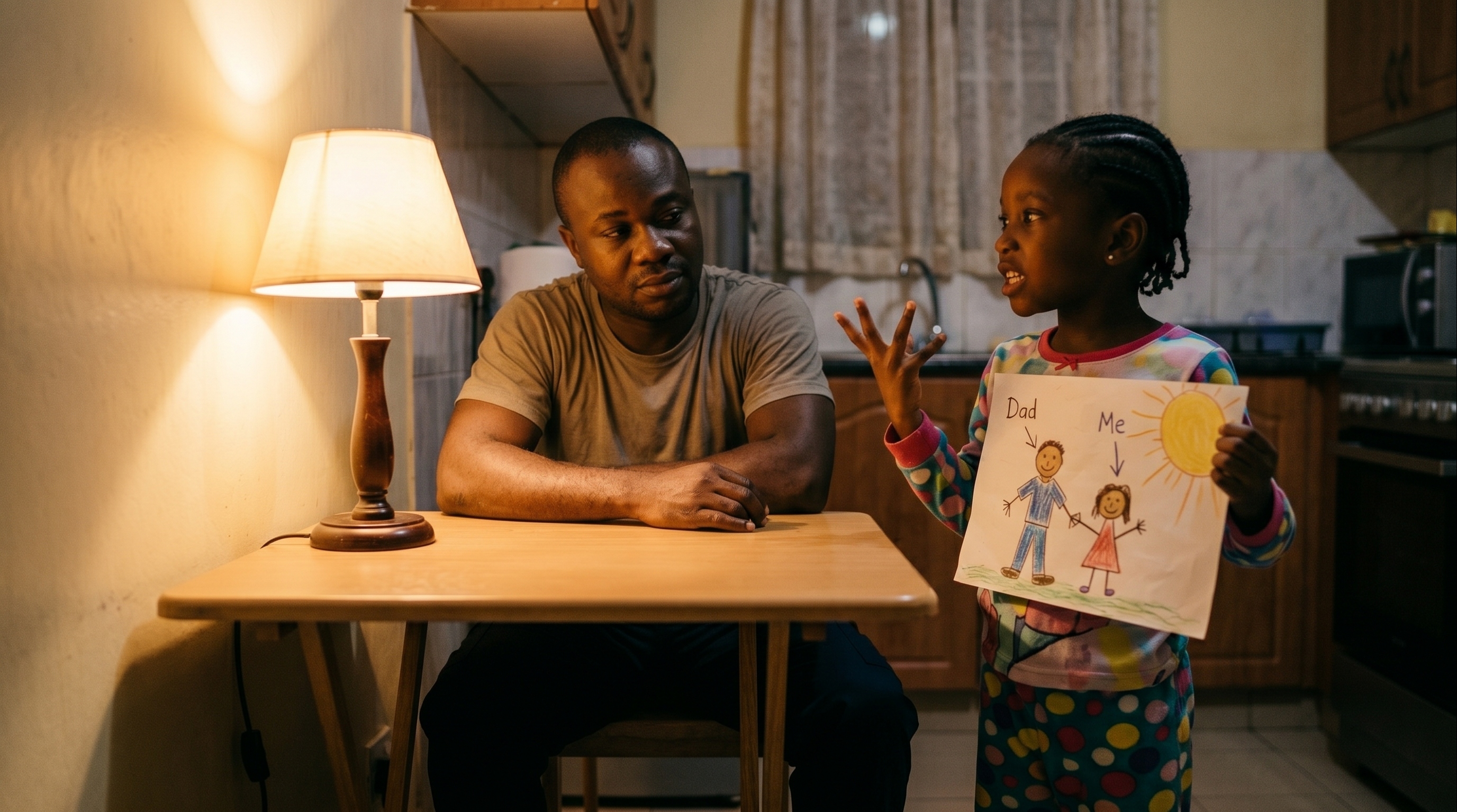
Emeka had been doing something at the dining table for nearly two hours. Long past his bedtime. When Kolade finally looked up and asked what he was doing, Emeka held up a picture: a man and a boy at a football field, both wearing the same colour shirts.
"That's you and me, Daddy," the boy said simply, without drama or accusation, and went to bed.
Kolade sat with that drawing for a very long time. He did not cry immediately. That picture was not just a drawing. It was a message. It was Emeka speaking the only language available to a child who doesn't yet have the emotional vocabulary to say, "Dad, I miss you and I need you here."
Here is what you need to know: children do not come to their fathers and say, "I need more of your time." They don't know how to say that, not directly.
What they do instead is far more subtle, far more layered, and if you're not paying close attention, dangerously easy to dismiss as mere behaviour. Every single thing a child does is communication.
The first thing you'll notice is that your child will start following you around the house for no apparent reason. Not because they need something. Not because they want to ask a question.
They will simply appear wherever you are.
Micro-moments of closeness, because that was all that was available. Children who shadow their fathers like this are not being difficult. They are being honest. They are physically closing a gap that they cannot close in any other way.
The proximity is intentional even when the child cannot explain it.
The second thing is that your child will begin to manufacture reasons to stay awake when you come home late. They will ask for water they don't need. They will complain of stomach aches that disappear the moment you sit beside them. They will suddenly remember homework that supposedly needs your help, even though it was fine all afternoon when you weren't home.
The invented ailments and excuses are not manipulation, but desperation in a form children can manage.
The third signal is when your child stops asking for you altogether. There comes a point in a child's emotional development, especially around ages 7 to 11, when they make a decision to stop reaching for something that doesn't seem to reach back.
If a father has been consistently unavailable, even with the best intentions, children begin to self-protect. They stop bringing their drawings. They stop appearing at the top of the stairs. They become self-contained in a way that looks like maturity but is actually emotional withdrawal.
A child who has given up on getting time with his father doesn't become fine. He becomes quiet.
Children use their fathers as mirrors.
Not in the way they use their mothers, which tends to be about safety and comfort and the regulation of immediate feeling. They use their fathers to understand their own value in the larger world.
When a father is engaged and present, a child reads that as confirmation: I am worth someone's time. I matter enough to be seen. When a father is absent, the child doesn't conclude that life is busy.
Children are not cynical. They conclude something far more personal: perhaps I am not interesting enough, perhaps I am not enough.
The disruption shows up later, especially, in adolescence, in the quality of friendships, in the ability to trust, in the way a young person relates to authority and to love.
The fourth behaviour is when your child begins performing for you. Not in an annoying way, but in a heartbreaking way.
They will suddenly want to show you everything: every drawing, every football trick, every sentence they can read, every fact they learned at school. They will drag you to their room to show you a toy you've seen a hundred times. They will ask you to watch them do something unremarkable with the seriousness and intensity of someone preparing for an audience with royalty.
What they are doing is creating opportunities for your gaze. They want your eyes on them. Not because they are vain.
Because a father's focused attention is one of the most powerful affirming forces in a child's life, and they know it, somewhere below language, somewhere in the body.
The fifth signal is one that shows up specifically in the space between a father and a child when time is being made, and it is the signal that tells you, that your child has been waiting.
Some children cry without understanding why when a father sits with them for an extended, unhurried period. Some become uncharacteristically talkative, telling stories that have been accumulating for weeks. Some become physically affectionate in ways that seem disproportionate to the moment .
This is not spoiling.
This is a child decompressing. This is the emotional equivalent of someone coming in from cold weather and standing near a fire.
What fathers need to hear is this: you do not need to become a different man. You do not need to empty your schedule or abandon your ambitions or transform overnight into someone who is constantly on the floor playing games.
Children are not asking for quantity in the way we tend to imagine. What they are asking for is quality of attention. The kind of attention that says: right now, in this moment, nothing in the world is more interesting to me than you. That kind of attention, given consistently, even in small doses, rewires a child's sense of self in ways that last a lifetime.
There is also something important to understand about what a father's involvement does to a child's emotional regulation which evolves around their ability to manage big feelings, to handle setbacks, to recover from disappointment.
Children who have regular, meaningful access to their fathers develop what psychologists call a more robust internal working model of relationships. They learn through their father's engagement that they are worthy of sustained interest, that the people who love them will not disappear when things get complicated, that it is safe to be known.

Comments (0)
Please sign in to join the conversation.
Loading comments...