

Folasade Adewale stood by her kitchen window on a Saturday morning, watching her nine-year-old son, Ayomide, arrange his toy cars in a straight line on the veranda tiles. It was such an ordinary scene, the kind that happens in a million homes every weekend, but something about it stopped her mid-stir of the yam porridge on the stove.
Ayomide was talking to himself, narrating a scenario where one car was "shouting" at another car for "bringing shame to the family."
She recognised the words instantly. They were her mother-in-law's words, spoken during last month's visit, when Folasade had accidentally broken a plate and been scolded in front of everyone.
She had brushed it off then. Standing at that window, she realised her son had not.
Children are always listening, always absorbing, always recording, even when nobody thinks they are paying attention. And it is rarely the big, dramatic events that shape them the most.
It is the small, repeated things.
These are the external factors quietly writing themselves into a child's understanding of what family, love, and safety are supposed to feel like.
When we talk about external factors in family dynamics, we are also talking about anything from beyond the four walls of your marriage that seeps into how you and your partner relate to each other and, by extension, how your children experience that relationship.
In-laws with strong opinions about how you should raise your children. Financial stress from a job loss or a business that is not doing well.
Comparison culture from social media, where every other family seems to be thriving in matching outfits and exotic vacations.
Cultural or religious expectations that pressure you to parent a certain way, even when it does not sit right with your own values.
Friends and extended family who insert themselves into disagreements that were never theirs to referee.
The danger is not in these forces existing but in leaving them unmanaged, letting them walk freely into your home and shape your household's emotional weather without any filter at all.
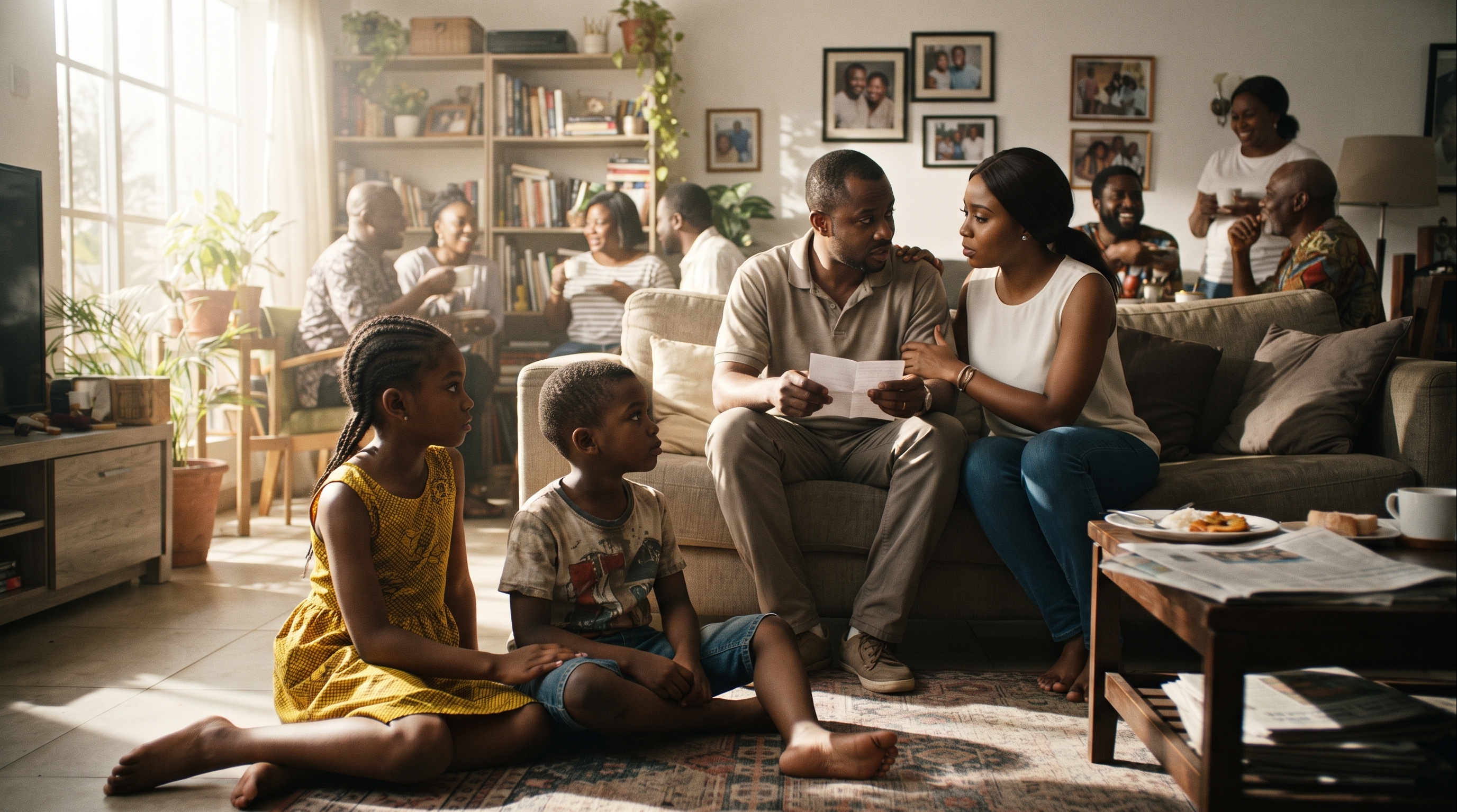
Tunde Adewale had grown up believing that a man's job was to provide, full stop. His own father had worked three jobs and rarely spoke of feelings, so Tunde carried that same silence into his marriage with Folasade, believing it was strength. When his tiling business slowed down during a difficult economic stretch, he stopped talking altogether.
He would come home, eat quietly, and disappear into his phone. Folasade, sensing the distance but unsure of its source, began pulling away too, spending longer hours on calls with her sister, venting about a husband who "did not care anymore."
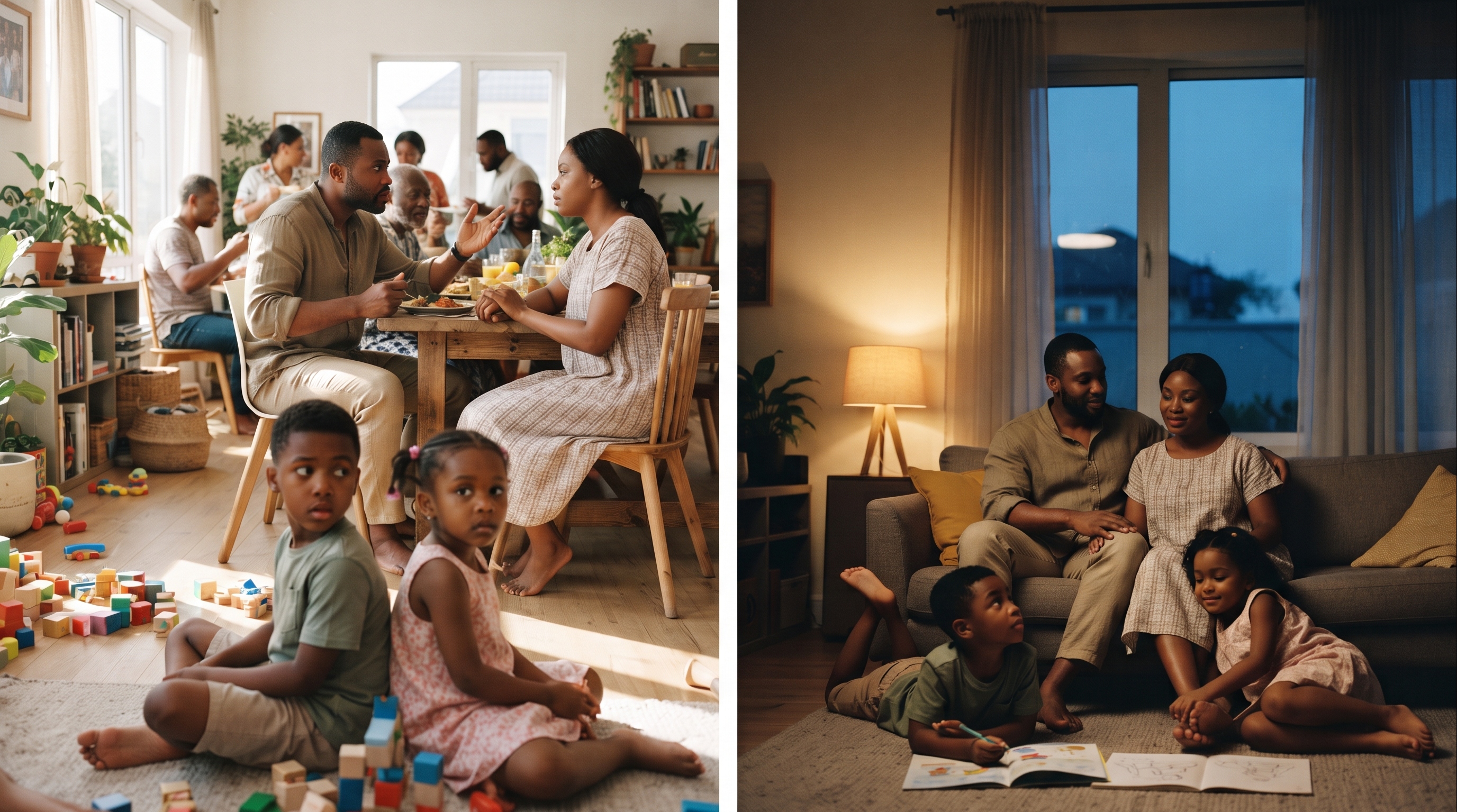
Neither of them noticed that Ayomide had started flinching whenever the front door opened too quickly. Neither of them noticed that their younger daughter, Iyanuoluwa, had begun drawing pictures of their house with no doors on it at all.
It was Ayomide's class teacher who eventually raised the alarm, mentioning gently during a parent-teacher meeting that he seemed withdrawn and anxious around loud voices.
Five Ways External Pressure Quietly Reshapes A Child's Growth
1. Emotional insecurity becomes the default setting. When children repeatedly witness unresolved tension caused by outside pressures, they begin to associate home with unpredictability rather than safety, and that insecurity often follows them into adulthood, affecting how they trust and attach in their own relationships.
2. They inherit unspoken beliefs about gender roles and self-worth. A child who repeatedly hears a grandmother criticise a mother's choices, or a father go silent under financial strain instead of communicating, absorbs a script about what men and women are "supposed" to do, long before they are old enough to question it.
3. Academic and social confidence takes a hit. Children carrying invisible emotional weight from home often struggle with concentration, peer relationships, and classroom participation, not because they lack intelligence, but because a part of their mind is always monitoring the emotional temperature at home.
4. They learn conflict avoidance or conflict explosion, and rarely anything in between. Kids model what they see. If external pressure causes their parents to either shut down completely or erupt suddenly, children rarely learn the middle ground of healthy, respectful disagreement.
5. Comparison culture teaches them to measure their family against a filtered highlight reel. Children exposed to a household anxious about "what people will say" or "what that other family has" often grow into adults who chase appearances over substance, unsure of what genuine contentment even feels like.
You did not fail simply because outside pressure entered your home. That is impossible to avoid entirely. Relatives will always have opinions. Money will always fluctuate. Culture will always exert its pull.
The failure is not in the pressure arriving, but in never pausing to notice how it is moving through your household and settling into your children's little hearts.
Stay alert to the tone you use after a stressful phone call.
Stay alert to how you speak about your in-laws or your partner's family when your children are within earshot, even if you think they are too young to understand.
Stay alert to how financial stress shows up in your voice, your patience, and your presence.
Stay alert to what your silence is teaching them, because silence is never actually silent to a watching child.
Practical Guidance You Can Start Today
Create a filter conversation with your partner about which outside voices influence your parenting decisions, and which do not.
Debrief after stressful family visits, naming what felt uncomfortable instead of burying it.
Practice narrating your emotions calmly in front of your children occasionally, so they learn that feelings are normal and manageable rather than frightening.
Limit how much financial anxiety is discussed within a child's hearing, without hiding the reality of resource limits entirely.
Watch your children's play, their drawings, their moods — these are often the clearest window into what is quietly shaping them.
Family life will never be free of outside noise, and that is not the goal.
The goal is awareness by staying alert enough to know what you are letting in, and intentional enough to decide what your children will carry forward.



Comments (0)
Please sign in to join the conversation.
Loading comments...