

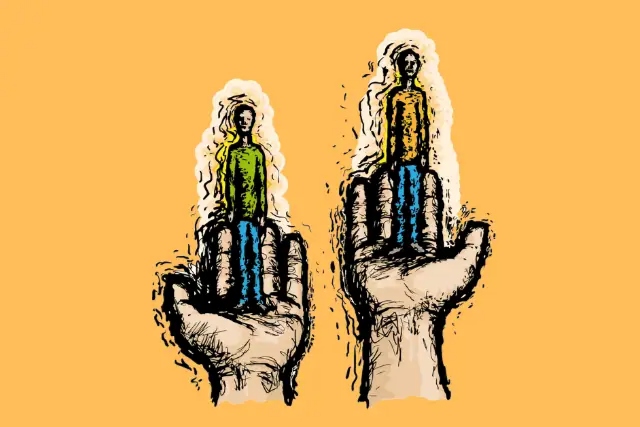
She would bring home a spelling test with a score of ninety-four written in red pen at the top, run into the kitchen where her mother was cutting onions for maraq, and hold it up with a kind of breathless pride, and her mother would smile, genuinely pleased, and say, "Masha'Allah, good, though your brother Cabdisalaan got a hundred on his last one, keep pushing."

It was said the way weather reports are said, as simple fact, a habit of measurement so automatic that Faduma never once noticed she was doing it, but Nasra noticed every single time.
Children raised close together and measured openly as a way of motivating effort fall into this pattern without ever meaning harm by it.
Comparing siblings rarely produces the drive parents hope for, and far more often produces a quiet, permanent sense in one child that their worth is only ever a reflection cast by someone else's achievements, never a light of their own.
Her brother, for his part, carried a weight nobody saw either, because being held up constantly as the standard meant he could never simply be a teenage boy who never failed; he had to be the measuring stick at all times, and that pressure sat on him just as heavily as the shadow sat on his sister.
When she turned 15, she was asked by her aunt, visiting from Toronto, why she had stopped showing anyone her art, since she used to sketch constantly as a younger child and hadn't picked up a pencil at the table in over a year.
Caught off guard by the direct, gentle question, she admitted quietly that she'd stopped because nothing she made ever got mentioned without her brother’s name attached somewhere nearby.
Her aunt sat with her niece at the kitchen table and simply listened, letting the silence stretch long enough for Nasra to keep talking, describing years of feeling like a supporting character in her own family's story.
Her mother overheard part of this conversation from the hallway, and something in her chest tightened uncomfortably, with real discomfort, that she had done to her daughter exactly what her own mother had done to her decades, holding up an older cousin's achievements as the constant unspoken benchmark, and she had sworn, as a young mother, that she would never repeat it.
Here are 10 real, practical actions worth trying to begin reclaiming your own sense of self while that slower work happens.
1 - Name the pattern plainly and calmly to your parent, saying something like "when you mention his grades right after mine, it makes my effort feel invisible," because most parents genuinely do not notice they're doing it until it's said aloud.
2 - Keep a private record of your own wins, whether in a journal or notes app, so your sense of progress depends on your own history and not on a sibling's parallel one.
3 - Third, resist the urge to compete quietly out of spite, since chasing a sibling's shadow just to prove a point usually leads you toward their goals instead of your own.
4 - Find one adult outside the house, a teacher, coach, aunt, or family friend, who sees your specific strengths and can reflect them back to you clearly and often.
5 - Protect your interests fiercely, especially the ones your sibling doesn't share, because those are the spaces where you exist fully as yourself rather than as half of a pair.
6 - Speak directly to your sibling sometimes too, since they are very likely carrying their own version of this weight and a shared conversation can turn quiet rivalry into quiet alliance.
7 - Practice noticing your own growth over time rather than your position relative to someone else, asking "am I better than I was last year" instead of "am I better than him."
8 - Allow yourself to feel proud out loud, even briefly, even if no one else brings it up first, because self-recognition is a skill that strengthens with repetition.
8 - Give your parents grace while still holding the boundary, understanding that comparison often comes from a parent's own unhealed upbringing rather than from any real doubt in your worth.
10 - Remind yourself often and firmly that a shadow only exists because there is a light behind it, and that light can just as easily be your own once you choose to stand somewhere it can reach you directly.
Her mother changed slowly, the way real change tends to arrive. She started catching herself mid-sentence, redirecting comments about her son into separate conversations entirely, and she began asking his sister specific questions about her art, her friendships, her own small daily victories, without folding her brother into the response at all.
Her daughter started sketching again, first quietly in her room, then eventually at the kitchen table where her mother could see, and one evening her mother looked over her daughter's shoulder at a drawing of their old neighbourhood and simply said, "This is beautiful, my daughter, it's completely your own," nothing more attached to it, no other name, no other measurement.
The sister didn't cry, but she felt something settle in her chest that had been unsettled for years, a quiet, steady confirmation that she could finally exist in her family's story as herself, fully lit, no longer standing in anyone else's shade.


Comments (0)
Please sign in to join the conversation.
Loading comments...