

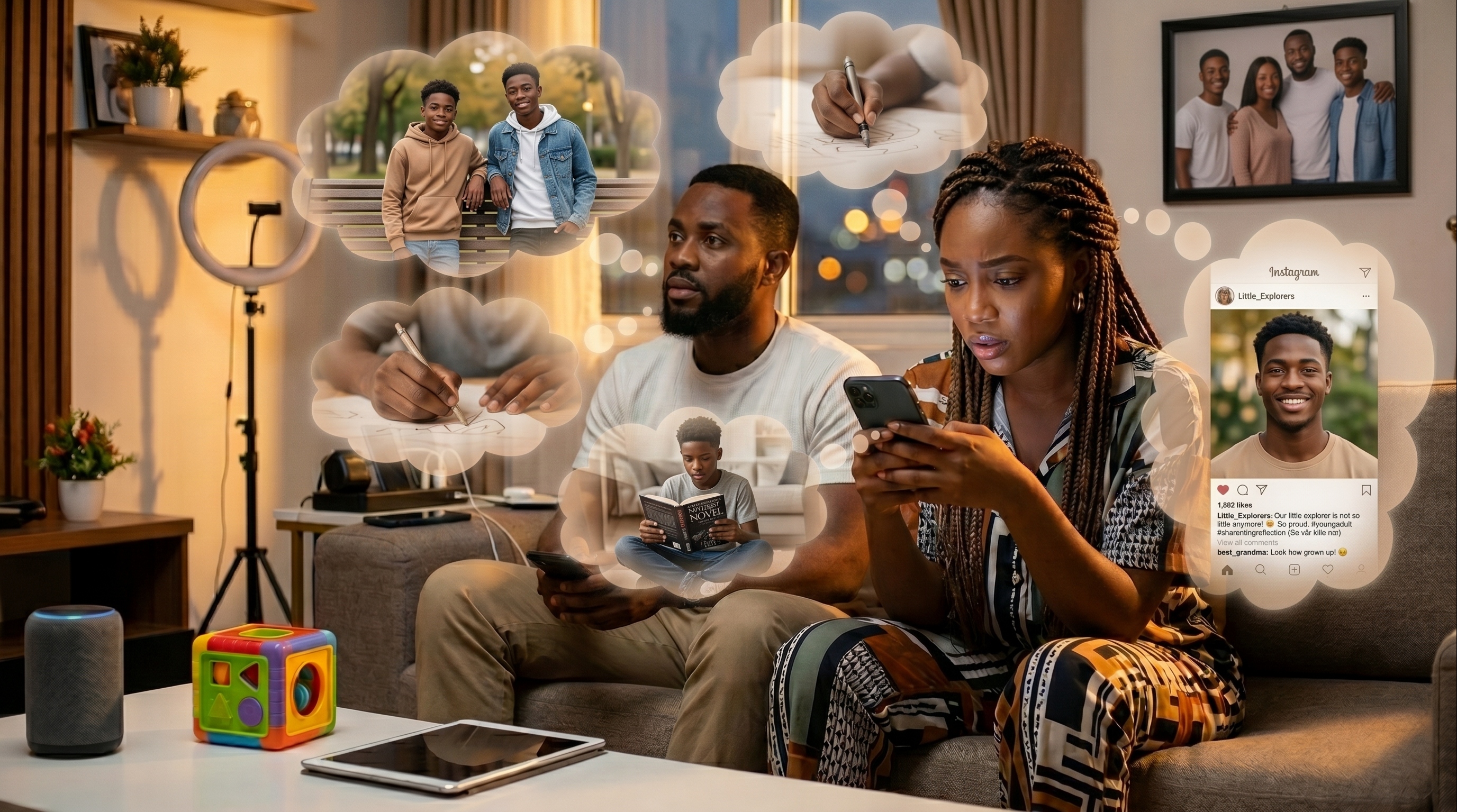
Social media, at its core, is not a bad thing. Let us be honest about that, because fear is never a useful starting point for parents. Platforms like TikTok, Instagram, Snapchat, X (formerly Twitter), and YouTube have given young people access to creativity, community, education, and self-expression that no previous generation ever had at their fingertips.

A teenager in Enugu can now learn photography from someone in London, find people who love the same obscure music they do, or discover career paths they would never have encountered through school alone. This is real, and it is genuinely beautiful.
(1) The same platforms that offer all of this also carry currents that are powerful enough to reshape your child's identity, emotional health, and understanding of relationships if no thoughtful adult is paying attention alongside them.
Your teenager, consciously or not, is learning to filter their personality through the question of what gets likes, what generates comments, what earns them followers.
This is a psychological response to an environment that is specifically designed to reward performance.
The algorithms on these platforms are built to show people more of what they already engage with, which means that if your child spends time watching content that glorifies risk-taking, emotional numbness, or relationship patterns that are unhealthy, the platform will serve them more of it, because engagement is the only metric it understands.
You, as a parent, are the only person in their life who can step into that loop with wisdom and context.
(2) The second trend that deserves your serious attention is the normalisation of emotional extremes in online content.
Scroll through the feeds most popular with teenagers today, and you will notice a striking pattern: content that is either wildly comedic or intensely dark tends to perform far better than anything that sits in the middle ground of ordinary, thoughtful human experience.
This is not melodrama but a genuine mental health concern, and it shows up not in dramatic breakdowns but in the quiet accumulation of how they think about themselves when no one is looking.
(3) Then there is the question of relationships and intimacy, which social media is reshaping in ways that are particularly relevant for young people approaching adulthood.
Platforms today are saturated with content about romantic relationships. Much of this content is performative, exaggerated, and disconnected from the reality of what building a genuine, lasting connection with another person actually requires.
As a parent, you don't need to ban this content, however, you need to be the voice that adds context to it, consistently and without judgment, so that your child develops the emotional literacy to see it for what it is.
(4) Create what might be called a culture of open digital conversation in your home.
This does not mean demanding passwords or installing tracking software, though there are situations where safety requires those measures. What it means, first and foremost, is making it genuinely safe for your child to talk to you about what they are seeing, feeling, and questioning online.
If your teenager knows that every mention of something they encountered on social media will be met with alarm, lectures, or punishment, they will stop mentioning it entirely, and then you are operating blind.
But if they have grown up understanding that you are curious rather than reactive, that you want to understand their world rather than shut it down, they will bring things to you. And that changes everything.
(5) It is also worth understanding the mental and emotional weight that social media places on young people through comparison and social validation.
Unlike the social hierarchies of previous generations, today's young people are measuring themselves against a global, curated, often artificially enhanced standard of beauty, success, intelligence, and social popularity.
This does not mean social media causes these things in every child because correlation is not causation, and individual resilience varies enormously. But it does mean that your child needs, more than any previous generation has needed, a strong internal foundation of self-worth that does not depend on external validation.
And that foundation is built primarily at home, in the ordinary moments of being seen, heard, and loved without condition.
(6) Something else that often gets lost in conversations about children and social media is the question of time, specifically, how much of your child's most formative psychological hours are being spent inside digital environments versus real-world ones.
When a significant portion of a young person's waking hours are spent in a highly stimulating, socially intense, algorithmically curated digital environment, those other inputs get crowded out.
This is not about being anti-technology but about understanding the nutritional requirements of a developing mind and making sure the diet is balanced.
The algorithm will never love your child.
It will never notice when they are struggling, or celebrate what makes them genuinely extraordinary, or sit with them in the dark moments of growing up. Only you can do that.
And that is a power worth taking seriously.
Comments (0)
Please sign in to join the conversation.
Loading comments...