

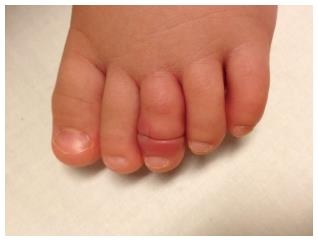
Your baby has been crying, not the usual hungry cry, not the tired whimper, but a high-pitched, inconsolable scream that makes your heart race. You check everything. Nappy? Clean. Temperature? Fine. Tummy? Not bloated. Yet, nothing you do seems to settle them. Most parents in that moment would never think to check between their baby's toes. But perhaps they should.

Hair tourniquet syndrome, sometimes called a hair or thread tourniquet, happens when a single strand of hair or a fibre from a sock, clothing, or blanket wraps itself tightly around a small body part. Most often, it winds itself around a baby's toe, finger, or in boys, the penis. Over time, that tiny strand tightens like a noose. It cuts off blood flow. It causes immense pain. If it goes unnoticed for long enough, it can lead to permanent damage or, in the most severe cases, the loss of a limb or digit.
It sounds terrifying, and in the right circumstances, it is. However, it is also entirely preventable, and the more parents know about it, the better.
Why It Happens More Than You Think
Hair tourniquet syndrome is more common than most people realise, and it tends to affect the youngest, most vulnerable babies, usually those under twelve months old. One reason it happens so frequently in this age group is that new mothers who are breastfeeding or experiencing the hormonal shifts of the postpartum period often shed significant amounts of hair. This is completely normal, but it means there is a great deal of loose hair in the environment.
Babies spend most of their time being held, carried, dressed, and undressed. Their tiny toes and fingers are constantly wrapped in socks, babygrows, and blankets, all of which can shed fine fibres. A single strand of hair can work its way into a sock and, when a baby flexes their toes or wriggles about, it can slowly tighten around a digit with each movement. The baby has no way of removing it, and the fibre or hair can become almost invisible once embedded in swollen skin.
What makes this particularly alarming is how quickly things can escalate. In some documented cases, tissue damage began within two hours of the tourniquet forming. In others, the strand was so fine it was invisible to the naked eye without the aid of a torch or magnifying glass.
The Warning Signs You Cannot Afford to Miss
The most important thing any parent or caregiver can know is what hair tourniquet syndrome looks like, because it does not always announce itself clearly.
The most common sign is prolonged, inconsolable crying in an infant who appears otherwise well. If your baby is screaming and you cannot find an obvious reason, this is a signal to carry out a head-to-toe check immediately, paying close attention to the toes and fingers. You are looking for any redness, swelling, colour change, or visible constriction.
In the early stages, the affected digit may simply look a little red or irritated at the base. As time goes on, it can swell considerably, and the skin may turn a deeper red, purple, or even blue. The strand may become deeply embedded and nearly impossible to see with the naked eye, particularly if the skin has begun to swell around it.
In older infants and toddlers who are mobile, there may be a noticeable reluctance to use a particular hand or foot, or visible distress when the area is touched. In boys, swelling of the penis is a particularly serious sign that requires immediate medical attention.
The crucial thing to understand is this: if the blood supply is cut off for long enough, the tissue begins to die. What begins as an easily solvable problem becomes a surgical emergency.
What to Do If You Find One
If you find what you suspect is a hair tourniquet, stay as calm as you can. Your next steps matter enormously.
Do not attempt to pull the hair out with your fingernails if it is embedded in the skin, as you risk breaking the skin and causing further injury. If the strand is clearly visible and sitting on the surface of the skin, you may carefully try to loosen it using a pair of fine-pointed scissors or a seam ripper, but only if you are completely confident you can do so without cutting the skin. Even then, proceed with great caution.
Many medical professionals recommend a product called a depilatory cream, a hair removal cream, as a gentler first option where the strand is not yet deeply embedded. The cream dissolves the hair, removing the constriction without any risk of cutting. However, this is only appropriate if you can see the hair clearly and the situation is not yet at a critical stage.
In any case, if there is visible swelling, discolouration, or you cannot clearly see or remove the strand, go directly to an accident and emergency department. Do not wait. Do not take a watch-and-see approach. This is a situation that requires prompt medical attention, and time genuinely is a factor.
At the hospital, doctors may use special instruments, a small incision, or, in some cases, a procedure under general anaesthetic to remove the tourniquet safely. The earlier you seek help, the simpler and safer the treatment.
How to Protect Your Baby
Prevention is always better than cure, and there are several practical steps that can make a real difference.
The single most helpful habit is what is known as a "toe check," making it a routine part of every nappy change to check between your baby's toes. It takes ten seconds. You part each toe gently and look for any strands of hair or thread. Over time, this becomes second nature, and it means any problem is caught before it has a chance to become serious.
Turning baby socks, babygrows, and mittens inside out before putting them on can help identify any loose threads or fibres that might cause a problem. Inspect clothing regularly, particularly items that have been worn or washed frequently, as stitching can come loose over time.
Parents who are experiencing significant postpartum hair loss, which usually peaks around three to five months after giving birth, should be particularly vigilant. Tying hair back when holding or nursing a baby reduces the chance of loose strands finding their way into clothing.
Some parents choose to cut out or remove the internal seams from their baby's socks, which removes the source of the problem entirely. Others opt for sock-free periods during the day where possible, particularly in warmer months.
Why This Is Not Talked About Enough
There is a strange gap in parenting education when it comes to hair tourniquet syndrome. It is covered in paediatric medical training, and it appears in nursing guidelines, but it is rarely included in the standard information given to new parents. Many doctors do not even mention it at all during postnatal visits.
This is not a criticism of those professionals who carry a significant workload and can only cover so much ground in a limited appointment time. However, it does mean that the responsibility for spreading this awareness falls, to a large extent, on parents themselves through social media, parenting forums, and conversations at playgroups and postnatal classes.
If you have never heard of hair tourniquet syndrome before reading this, you are not alone. Now that you know, you are in a position to protect your baby and to share this information with every parent you know.
A Quick Summary to Keep in Mind
Hair tourniquet syndrome happens when a strand of hair or thread wraps tightly around a baby's toe, finger, or genitalia. It cuts off the blood supply, causes significant pain, and can lead to lasting damage if not treated promptly.
The main warning sign is inconsolable crying in an otherwise healthy baby. Routine toe checks at every nappy change are the most effective prevention. If you find or suspect a hair tourniquet, seek medical attention without delay. It is a small thing to check and could make an enormous difference.



Comments (0)
Please sign in to join the conversation.
Loading comments...