

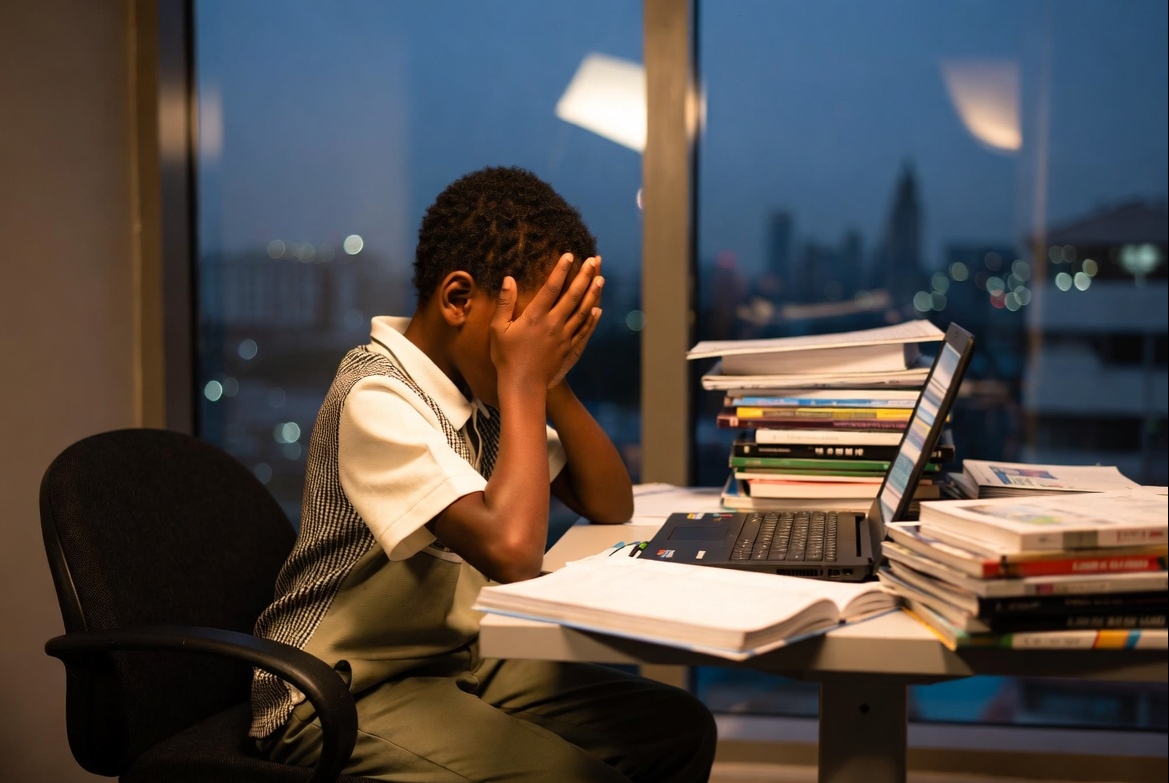
There is a particular kind of silence that settles over a house when a ten-year-old sits at a desk at nine o'clock in the evening, staring at a worksheet that still is not finished. It is not the peaceful quiet of a child absorbed in a book they love, or the hush of a little one drifting off to sleep after a day full of running and laughing and simply being young. It is the silence of exhaustion. It is the silence of a childhood that is quietly slipping away one homework sheet, one revision session, one practice test at a time.

This is not a dramatic exaggeration. It is a scene playing out in homes across the globe, night after night, and many of us have grown so used to it that we have stopped questioning whether it is normal or whether it should be.
The Pressure Starts Earlier Than You Think
Most people assume that serious academic pressure begins somewhere around secondary school with GCSEs, WAEC, A-levels, and university applications. However, for many children today, the pressure begins in primary school. Some children are being assessed, ranked, and prepared for standardised tests as young as six or seven years old. By the time they reach Year 6, many ten and eleven-year-olds are sitting mock SATs papers, attending booster classes, and being told, in ways both direct and indirect, that their worth is tied to a number on a page.
Unusual Infant Behaviors That Can Make You Worried
This is not to say that learning is bad, or that schools are doing something deliberately unkind. Teachers are under enormous pressure too. They are working within a system that measures success in very narrow ways, and they are doing their best within it. Yet, the question we need to ask is not whether individuals within the system are trying hard. The question is whether the system itself is asking too much of children who are still very much in the process of becoming.
What Childhood Actually Needs to Be
Childhood is not simply a rehearsal for adulthood. It is its own important, irreplaceable stage of life. One with its own developmental needs that cannot be rushed or substituted. Your children need free, unstructured play. Not organised activities, not structured enrichment, not guided learning disguised as fun. Actual free play, where nothing is being measured and no one is keeping score.
They need time to be bored. This might sound counterintuitive, but boredom is where creativity lives. When a child has nothing handed to them, they invent something. They tell stories, they build worlds, they discover what they actually enjoy. This is how children come to know themselves, not through a curriculum, but through freedom.
They need to move their bodies, not because it improves focus or boosts academic performance (though it does), but simply because movement is joy, and joy is not a luxury. They need to spend time with their friends and family without a revision timetable looming over the weekend. They need to feel, in the very marrow of their bones, that they are loved and valuable not because of what they achieve, but because of who they are.
When you fill every hour with structured learning, you are not giving your children more. Instead, you are taking something away.
The Anxiety That No One Talks About Enough
The mental health figures are stark, and they should alarm every one of us. Children are arriving at school already anxious. They are lying awake at night worrying about tests. Some are experiencing physical symptoms, such as stomach aches, headaches, and disrupted sleep, that are directly linked to the stress of academic expectations.
The really troubling part is that many of these children have internalised the idea that this stress is simply the price of success. They do not question it. They have been taught, by a culture that glorifies achievement above everything else, that feeling overwhelmed is just part of trying hard.
However, feeling overwhelmed is not the same as being challenged in a healthy way. There is a meaningful difference between the productive discomfort of stretching yourself and the chronic stress of never being allowed to rest. You are confusing the two, and your children are paying the price.
The Parents Caught in the Middle
It would be unfair to look at this issue without acknowledging how difficult the situation is for parents. Many parents are not pushing their children because they are cold, ambitious, or out of touch. They are pushing because they are frightened. They see a world that feels increasingly competitive, increasingly unforgiving, and they believe, not without reason, that falling behind in education can have long-term consequences for their child's future.
This fear is understandable. The worry that your child will be left behind, that the doors of opportunity will close before they even get to knock, is one of the most powerful forces in modern parenting. Yet it is worth asking honestly: are you preparing your children for a fulfilling life, or are you preparing them for a performance? What does it cost them, emotionally and developmentally, when every year of their childhood is treated as preparation for the next?
A child who grows up never knowing stillness, never discovering what they love for its own sake, never allowed to fail in a low-stakes environment and learn from it, that child may well get excellent marks. But they may also arrive at adulthood without a strong sense of who they are, without resilience, and without the inner resources to cope when life inevitably gets hard in ways that no exam can prepare you for.
What You Could Do Differently
The conversation about academic pressure does not have to end in despair or in blame. It can end in a different kind of question: what would it look like to give my children back some of what they are losing?
It might mean being more protective of evenings and weekends, treating them as genuinely sacred family time rather than overflow space for homework. It might mean having honest conversations with children about the fact that a test result does not define them, and then actually meaning it, not just saying it before asking how the revision is going. It might mean finding small, consistent ways to honour the parts of your child that have nothing to do with school. That is, their humour, kindness, curiosity, and imagination.
On a broader level, it means continuing to push for an education system that values the whole child, not just their academic output. Countries like Finland have long demonstrated that children can achieve excellent educational outcomes without sacrificing childhood by starting formal schooling later, limiting homework in the early years, and prioritising wellbeing alongside attainment. The evidence is there. The question is whether we have the political and cultural will to act on it.
A Final Thought
There will come a day, sooner than any parent is ever ready for, when your child will be grown. When that day comes, they will not remember the WAEC paper they sat in SSS3, or the grade they got on a mock exam. They will remember whether they felt safe and loved. They will remember the afternoons they were allowed to just be a child. They will remember whether childhood felt like something to be survived or something that was genuinely, joyfully theirs.
You still have time to make sure they remember the right things.


Comments (0)
Please sign in to join the conversation.
Loading comments...