


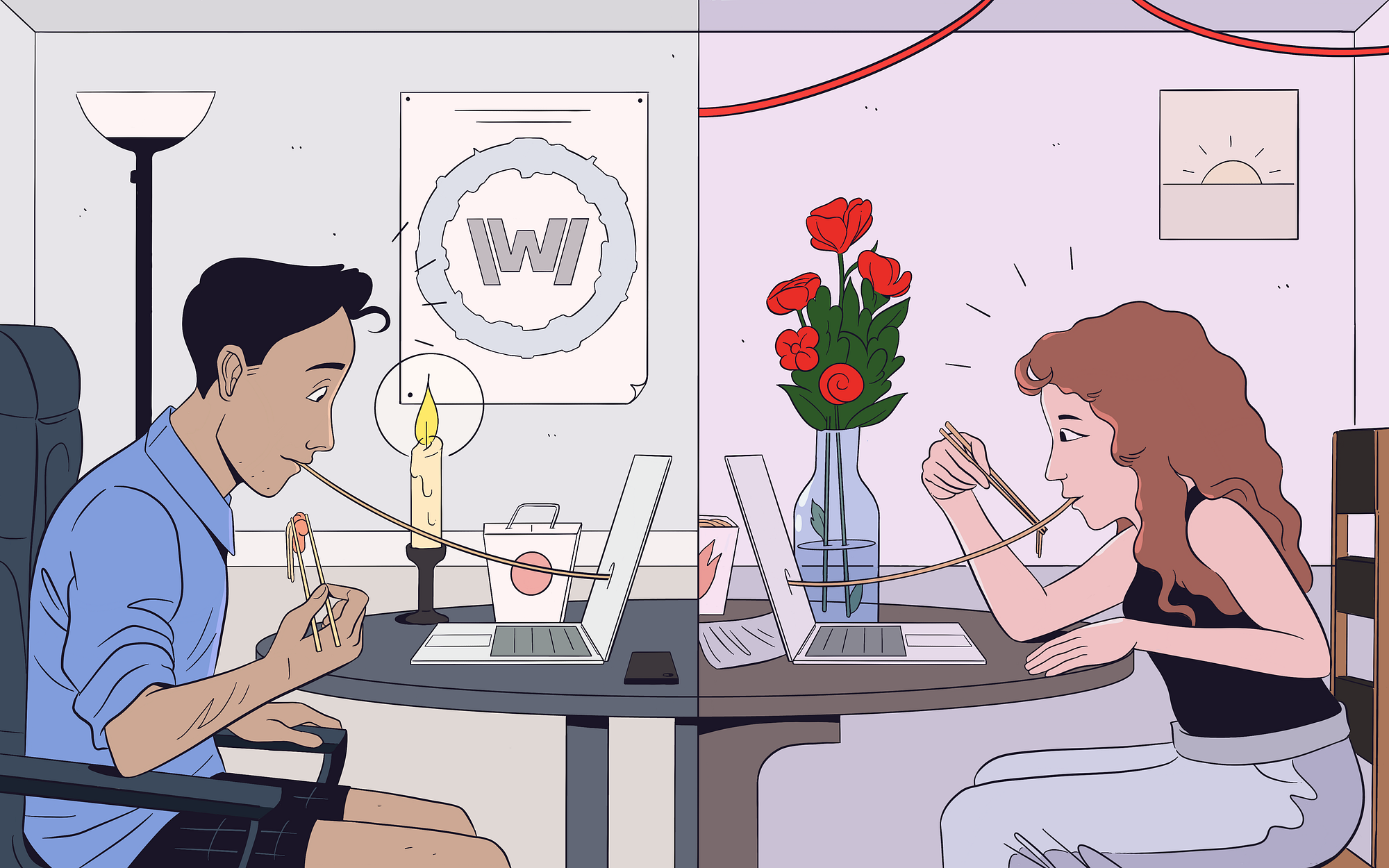
Yasmine Chaouachi had been waiting, not impatiently, just hopefully, for Idris to put down his phone. They hadn't properly talked all day. She had a story she wanted to share, something funny that had happened at work, the kind of small, warm, throwaway story that becomes the texture of a shared life, and she kept almost starting it, then stopping, because Idris's eyes were fixed on his screen, his thumb moving in that slow, hypnotic scroll that anyone who has watched a partner disappear into a phone will immediately recognise.

She said his name once. He said "mmm" without looking up. She said it again. He smiled at his screen, and said, "Sorry, wait, this one is actually hilarious." She waited. The hilarious video ended. Another one began. Yasmine quietly got up, made herself a cup of tea, and went to bed alone.
She didn't say anything that night. Not because she was being passive-aggressive, but because she genuinely wasn't sure what to say, and because some part of her suspected, correctly, that this was bigger than one Tuesday evening.
This is the story of how ‘just one more video’ quietly becomes one of the most underestimated threats to modern relationships.
1. The Scroll Is Designed to Be Irresistible, And That's Not an Accident
Before we talk about what this does to relationships, we need to talk about what we're actually dealing with because Idris is not a bad partner and Yasmine is not being oversensitive. What Idris is fighting, without fully knowing it, is one of the most sophisticated attention-capture systems ever built by human beings. Social media reels are engineered by entire teams of behavioural scientists and data engineers to be precisely, almost surgically, engaging. The content refreshes infinitely, the algorithm learns your preferences in real time, and every video is paced to end just as your brain is releasing a small hit of dopamine, perfectly timed to make "just one more" feel like the most natural thing in the world. Understanding this is about understanding the actual scale of what couples are navigating. You are not competing with a hobby. You are competing with a machine.
2. Presence Without Attention Is Its Own Kind of Loneliness
One of the loneliest feelings in a relationship is not being physically alone. It's being physically next to someone who is emotionally somewhere else entirely. Yasmine wasn't lonely in the way that single people sometimes describe loneliness. She was lonely in a more confusing, more painful way that makes you question whether you're being too needy, whether you're making a big deal out of nothing, whether this is just ‘modern life’ and you should simply adjust. That particular brand of loneliness, the kind that lives in a shared apartment next to someone you love, is one of the most quietly corrosive forces in contemporary relationships. It doesn't announce itself. It just accumulates, like dust in a corner, until one day you realise the room feels entirely different from how it once did.
3. It Rewires What Counts as "Enough" in a Relationship
Rania Belhaj, Yasmine's closest friend in Sfax, described something remarkably similar happening in her own relationship with her boyfriend Mehdi. "The strange thing," Rania told Yasmine over coffee one afternoon, her hands wrapped around a small ceramic cup, "is that we're technically together all the time. He comes home, I come home, we eat together, we sleep in the same house, and yet I feel like I haven't actually seen him in months." What Rania was articulating is what psychologists call co-presence without connection. The phenomenon where two people share time and space but are no longer genuinely inhabiting the same emotional moment. Over time, this becomes the new normal. The bar for what counts as "spending time together" quietly drops, and both partners start to unconsciously accept a version of closeness that is really just proximity.
4. Conversations Start to Feel Like Interruptions
One of the more painful things that Yasmine noticed, roughly two months into this pattern, was that she had begun to preface things she wanted to say with apologies. "Sorry, I know you're watching something, but—" or "This can wait if you're in the middle of something." She was apologising for wanting to talk to her own partner. And Idris, to his credit, wasn't doing this deliberately. He wasn't withholding attention as punishment or making a conscious choice to prioritise his phone over Yasmine. He had simply, gradually, recalibrated his defaults. The phone had become the primary activity. Yasmine had become the interruption. And neither of them had formally agreed to this arrangement. It had just happened.
5. The Algorithm Feeds You a World Where Everyone Else Looks More Interesting
Here is a dynamic that almost nobody talks about openly but that almost everyone in a long-term relationship has felt at some point: the subtle, insidious effect of watching an endless stream of curated, entertaining, aesthetically perfect strangers on the internet. Social media reels are not a neutral experience. They are a highlight reel of the most compelling moments of thousands of other people's lives — their funniest stories, their most beautiful trips, their most charming personalities, all filtered and edited and set to music. A partner who spends hours in that world and then returns to the quiet, ordinary, wonderfully imperfect reality of a real relationship is making a cognitive transition that is harder than it sounds. Real life requires patience, attention, and a willingness to be bored sometimes. Reels train your brain to expect constant stimulation. The two are not easily compatible.
6. Small Moments Are Where Intimacy Actually Lives
Yasmine eventually said something to Idris one morning over breakfast when the mood was light, and the conversation was easy. She said, "I miss talking to you in the evenings. Like properly." Idris looked up from his coffee. "What do you mean? We talk." And Yasmine said, gently, "We're in the same room. That's not the same thing." There was a pause, and then Idris put his mug down and said, "You're right. I didn't realise." That conversation lasted forty minutes. It was the best forty minutes they'd had in months. And it started because Yasmine named a small thing truthfully. After all, the small moments, the ordinary Tuesday evening conversations, the shared laughter over nothing important, are not small at all. They are the entire architecture of intimacy. They are what love is actually made of, in practice, on a Tuesday.
7. Your Phone Habits Are a Form of Communication
This is one that partners rarely frame this way, but it is genuinely true: how you handle your phone in the presence of your partner sends a clear, consistent, ongoing message about where they sit in your hierarchy of attention. When Idris scrolled through reels while Yasmine sat beside him hoping to connect, he was not saying anything. He was communicating, without words, that what was on his screen was more worthy of his focus than she was. He didn't mean it. But intentions and impacts are two different things, and in relationships, it is the impact that accumulates. Your phone habits are a love language in reverse, and most of us have never examined what our default habits are actually saying.
8. The Comparison Trap Hides Inside the Scroll
There is another layer to this that affects both partners differently. For the person scrolling, the constant exposure to charismatic creators, perfectly narrated lives, and endlessly entertaining content can subtly shift internal benchmarks — not necessarily in a dramatic, conscious way, but in the way that sustained exposure to anything always does. For the partner watching the scrolling happen, there is sometimes a quieter, sadder version of the same trap: a creeping sense of inadequacy, a wondering whether they are interesting enough, engaging enough, entertaining enough to compete with whatever is on that screen. Neither of these dynamics is healthy. Both are extremely common. And both are, at their root, the product of a technology that was never designed with your relationship in mind.
9. Boundaries Around Screens Are an Act of Love, Not Control
When Idris and Yasmine eventually talked properly, they made a quiet agreement. No phones during dinner. No scrolling in bed after 10 p.m. Not as rules handed down from one partner to the other, but as a mutual decision, made together, about what kind of relationship they actually wanted to have. This distinction matters enormously. A boundary that comes from one person demanding and the other complying is a power dynamic. A boundary that comes from two people deciding together is an act of shared love; a declaration that this relationship is something worth protecting, worth designing intentionally, worth showing up for with your whole, undistracted self.
10. Boredom Together Is Wildly Underrated
Here is something that sounds almost counterintuitive but is actually one of the most relationship-sustaining truths out there: the couples who can be bored together — genuinely, quietly, unstimulated together — are building something that couples who are always entertained are not. Boredom is where spontaneity lives. It's where you end up having the conversation you didn't plan to have, the one that goes somewhere unexpected, the one you'll both remember years later. When every spare moment of silence is filled with a reel, those conversations never happen. The space for them never opens. Protecting some genuine, unscheduled, unscreened time together is about keeping the channels of your relationship open and clear.


Comments (0)
Please sign in to join the conversation.
Loading comments...