

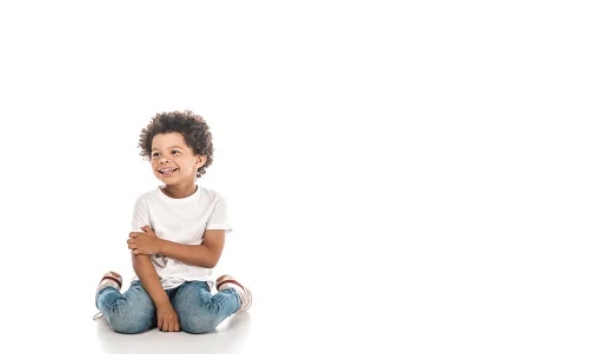
Mama Nzé noticed it on a Tuesday evening, the kind of ordinary evening where nothing seems worth remembering. Her daughter, Ayingone, four years old and full of chatter, was sprawled on the parlour floor building a tower out of empty tins, her knees bent outward and her feet tucked behind her like two commas framing her small body.
It looked harmless and kind of sweet. But Ayingone's older brother, Obame, who was studying to become a physiotherapist, stopped mid-sentence and said, "Mama, she's sitting in a W again..."
What Exactly Is "W-Sitting"?
Picture a child sitting on the floor with their bottom between their heels, knees bent and pointing forward, legs splayed out on either side like the two humps of the letter W. It's a position many children fall into naturally, especially when they're playing, because it feels stable.
The base is wide, the torso doesn't have to work hard to stay upright, and little hands are freed up to build, draw, or stack blocks without wobbling. That stability is exactly what makes it so tempting, and exactly what makes it worth watching.
Why Children Gravitate Toward It
Children aren't choosing the W-sit out of stubbornness or bad habit. Their bodies are choosing it for them. When a child's core muscles, the deep abdominal and back muscles that keep the trunk steady, haven't fully matured yet, the W-sit offers a kind of shortcut. It widens the base of support so the child doesn't have to engage those muscles as much to stay balanced.
In other words, the position does the balancing job that the muscles are supposed to be learning to do themselves. It's comfortable in the short term precisely because it lets the body avoid a bit of necessary work.
The Real Concern: What Happens Over Time
1. Weaker core and trunk muscles.
Because the W-sit reduces the need for active balancing, children who sit this way for months or years may develop weaker abdominal and back muscles than children who rotate through varied sitting positions.
2. Tight hips and hamstrings.
The position holds the hip joints in an inward-rotated posture for extended periods, which can gradually tighten the muscles around the hips and thighs, making other movements, like squatting or running with a wide gait, feel stiffer over time.
3. Delayed coordination between both sides of the body.
Many everyday skills, such as buttoning a shirt, catching a ball, and writing while holding paper steady, require the two sides of the body to work together. Some therapists have observed that children who W-sit frequently get fewer chances to practice this cross-body coordination because the position doesn't demand it.
4. Potential impact on gait and posture.
In some children, prolonged W-sitting has been linked to a slightly pigeon-toed walking pattern or a posture where the knees turn inward, simply because the hips have adapted to sitting in that rotated position for so long.
5. A pattern that becomes hard to unlearn.
The longer a child sits this way, the more natural it feels, and the harder it becomes to redirect them toward other positions later.
None of this means a child who W-sits occasionally is doomed to struggle. The main takeaway is not to panic, but to watch for a W-sit that becomes the default, the automatic, almost exclusive way a child rests on the floor, day after day, month after month.
Practical Ways To Help, Without Turning It Into a Battle
- Offer furniture that supports better posture.
A small chair or stool during activities like drawing or eating snacks removes the temptation to flop into a W on the floor.
- Turn correction into a game, not a scolding.
Children respond far better to playful redirection, like naming other sitting positions after animals or shapes, than to being told they're doing something wrong.
- Encourage floor play that naturally shifts position.
Games that involve reaching, crawling, or rolling get children out of static postures altogether and build the very core strength the W-sit tends to bypass.
- Involve older siblings as quiet role models.
Children copy the people closest to them far more than they copy instructions, so a sibling who sits differently nearby can shift a habit without a single word being said.
- Watch, but don't panic.
Occasional W-sitting is common and not automatically harmful. The goal is variety, not the complete banning of a position that many children fall into naturally.
- Talk to a paediatrician or physiotherapist if it seems constant.
If a child sits in a W almost every single time, especially past the age of five or six, or if there are already signs of stiffness or an unusual walking pattern, a professional opinion can offer real clarity rather than guesswork.
Noticing it early, addressing it gently, and involving the whole household, from parents to older siblings, turns a potential problem into a simple, shared family adjustment.


Comments (0)
Please sign in to join the conversation.
Loading comments...