

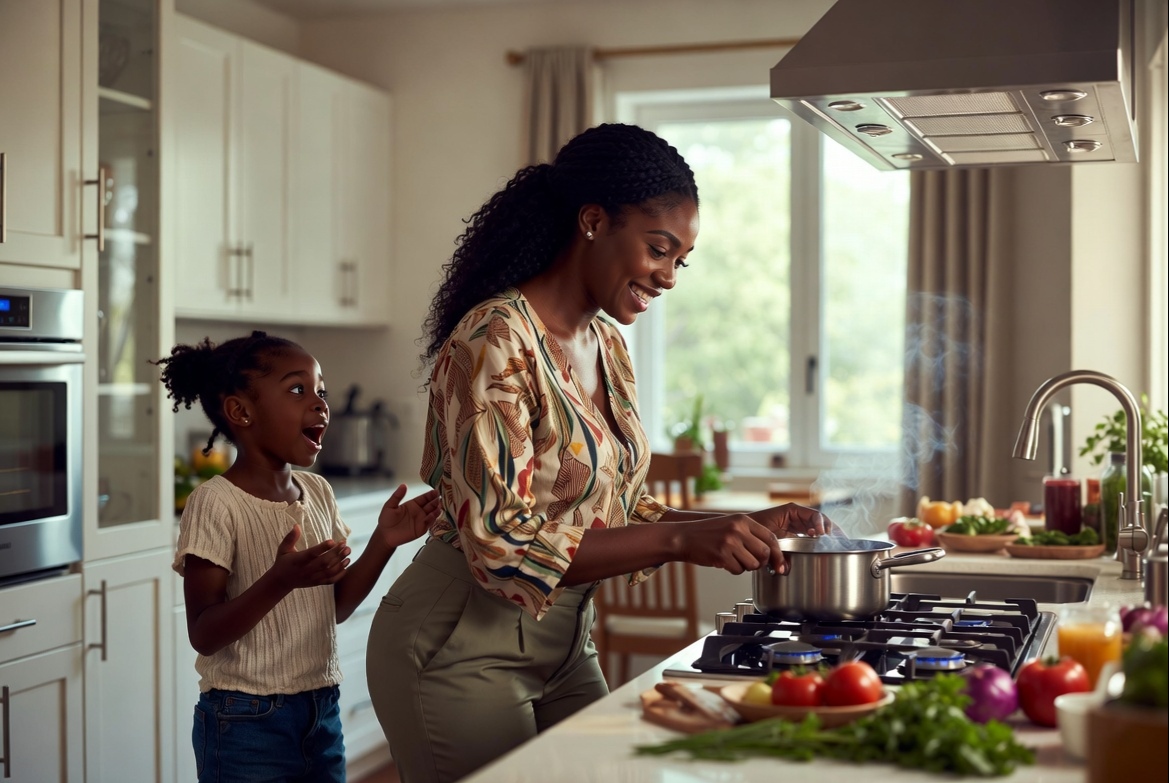
There is a moment, and every parent remembers it, when you realise your child has stopped simply existing in the world and started interrogating it. Your child is not trying to drive you mad. They're just trying to understand the world and they chose you to explain it.

It happens quietly at first. "Why is the sky blue?" Fine. Lovely, even. You feel like a proper parent, answering thoughtfully. Then comes, "But why is air there?" Then, "Where did air come from?" Then, "Did God make the air or did the air make God?" and suddenly it's half past seven in the morning, you haven't had your tea, and you're deep in an existential crisis with a person who still needs help putting their shoes on the right feet.
Welcome to the Question Asking Phase.
Protect Your Child From Abuse By Doing These Things
It typically kicks in somewhere between ages two and five, though some children carry it well into primary school and honestly, the bright ones never really stop. Across every culture, every continent, every language, this phase is universal. Children in Lagos ask why the rain comes. Children in London ask why the sky goes dark. Children in Tokyo ask why people die. The questions are different. The hunger behind them is identical.
This phase is not a problem to solve. It is a privilege to witness. However, it does require you to show up in a particular way, and most of us were never taught how.
Here are five things you genuinely need when your child reaches this phase. Not things to buy. Things to become.
1. The Courage to Say "I Don't Know"
This is the one that catches most parents off guard.
We were raised in a world where adults were supposed to have the answers. The teacher knew. The parent knew. Not knowing felt like failure. So when your child asks something you genuinely cannot answer, and they will, constantly, the instinct is to either bluff your way through or shut the question down entirely.
Don't.
"I don't know, shall we find out together?" is one of the most powerful sentences you will ever say to your child. It teaches them that curiosity is not a phase to grow out of. It teaches them that not knowing is the beginning of learning, not the end. It models intellectual humility, something the world is desperately short of right now.
Children who are raised by parents who admit uncertainty grow into adults who are comfortable with complexity. That is not a small thing. That is everything.
2. Patience That Goes Deeper Than You Think You Have
Here is the honest truth: you will lose it sometimes. You will be tired, overstretched, and three questions into a chain that began with why the biscuit tin is on the top shelf, and you will snap. That is human. That is fine.
But the thing you need, the practice you need, is the ability to return to patience quickly. To repair the moment. To come back and say, "Sorry, I was tired. What were you asking?"
Research from developmental psychologists across the globe consistently shows that children who feel safe asking questions in childhood are more creative, more resilient, and more emotionally intelligent as adults. The questions are not just about information. They are about connection. Every "why" is also a quiet version of "are you there? Do you see me? Can I trust you with my mind?"
Patience is not the absence of frustration. It is the decision to stay present anyway.
3. A Curiosity of Your Own
Children are extraordinarily good at detecting inauthenticity. If you are going through the motions, giving flat, dismissive answers just to get to the next task, they feel it. The questions thin out. The light behind their eyes dims a little. They learn, without a single word being spoken, that wondering out loud is not welcome here.
The antidote is simple, though not always easy: let yourself be curious too.
When your child asks why worms come out after rain, be genuinely interested in the answer. Look it up together. Be delighted by it. Tell them that it's because the vibrations on wet soil mimic the vibrations made by moles, so worms surface to escape; isn't that extraordinary? When they ask why people cry when they're happy, sit with the question rather than batting it away. Wonder about it aloud.
A parent who models curiosity gives their child permission to be curious forever. In a world that will increasingly reward creativity and original thinking, this is one of the greatest gifts you can offer.
4. Simple, Honest Language
Here is where many well-meaning parents go wrong: they either over-explain or they oversimplify to the point of dishonesty.
Children, even very young ones, can handle truth when it is delivered with warmth and at the right level. You do not need to lie about death, about where babies come from, about why people are unkind, about why some families have less money than others. What you need is the skill of translating, of finding the honest answer in language that fits where your child is right now.
"People die because their body stops working, like a toy whose batteries run out and can't be replaced." That is honest. That is kind. That is enough for a three-year-old.
Simple language is not dumbed-down language. It is precise language stripped of jargon, evasion, and the complexity that is really just adult discomfort in disguise.
5. A Long View
The Question-Asking Phase will exhaust you on some days. There will be evenings when you have answered forty-seven questions, and the forty-eighth breaks you a little. There will be mornings when you just want to drink your coffee in silence and your child wants to know why silence exists.
On those days, take the long view.
The child peppering you with questions at five is building the mental architecture they will use at thirty-five. Every question you engage with, even imperfectly and tiredly, lays one more brick in that structure. Every moment you say "that's a brilliant question" instead of "not now" sends a signal that echoes for decades.
You are not just answering questions. You are teaching a person how to think. How to wonder. How to hold open questions without panic. How to trust that the world is worth understanding.
The phase ends. The person it builds does not.
One Last Thing
Parents across the world are navigating this same beautiful, maddening phase right no, in flats in Lagos, in farmhouses in rural France, in high-rises in Seoul. None of us were trained for it. Most of us are doing it on too little sleep and too much self-doubt.
But the fact that you are reading this, that you want to show up better for the questions, v means you are already doing the most important thing.
You are paying attention. Your child, whether they can say it yet or not, knows exactly what that means.
Comments (0)
Please sign in to join the conversation.
Loading comments...