

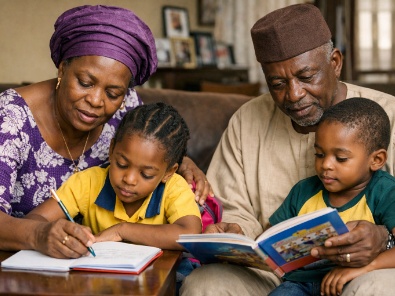
• What often starts as temporary childcare support is turning into long term responsibility for many older adults.
- More grandparents are quietly becoming full time parents again due to migration, divorce, economic hardship, and family breakdown.
• Experts warn that while this arrangement is built on love, the emotional, financial, and physical strain on elderly caregivers is growing.
When 67 year old Mama Grace thought about retirement, she imagined rest. She imagined morning devotion without rushing, visits from her grandchildren during holidays, and finally having time to take care of her health.
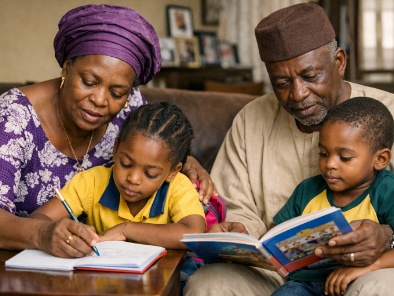
Instead, she wakes up at 5am every weekday to prepare two children for school.
Her daughter relocated abroad five years ago in search of better opportunities. What was meant to be a short term arrangement slowly became permanent. School fees increased. Feeding became more expensive. One child developed asthma. Mama Grace adjusted her life quietly. She used her pension for textbooks. She postponed her own medical checkups. She told neighbors she was “fine.”
Across Nigeria and beyond, her story is not unusual.
A Growing Reality in Many Homes
More grandparents are becoming full time parents again. Some step in because their children migrate. Others do so because of divorce, death, teenage pregnancy, financial hardship, or unstable relationships. In certain cases, parents are simply unprepared for the responsibility and rely heavily on their own parents to carry the weight.
At first, it often feels temporary. A few months of support. A year at most. But over time, the arrangement becomes the new normal.
What makes this situation complex is that it is built on love. Most grandparents do not hesitate. When a child needs stability, they step in without complaint. They believe family comes first. They believe blood is responsibility.
But love does not remove the burden.
The Silent Cost Behind the Sacrifice
Parenting in later years is physically demanding. Running after young children, attending school meetings, managing hospital visits, and enforcing discipline require energy many older adults no longer have in abundance. For those managing high blood pressure, arthritis, or diabetes, the stress can be intense.
Financial pressure adds another layer. Many retirees survive on modest pensions or small businesses. Suddenly, they are responsible for school fees, uniforms, feeding, and medical bills. Some dip into savings meant for old age. Others quietly accumulate debt.
Emotionally, the strain is even deeper.
Some grandparents feel disappointed in their adult children but suppress it to protect family unity. Others feel guilt, wondering if they somehow failed in raising the parents who now seem absent. Yet in public, they smile. They attend school events. They post proud photos. They rarely speak about the exhaustion.
What About the Children
Children raised by grandparents often grow up surrounded by affection and cultural values. They hear stories of the past. They learn respect. They experience stability that might otherwise be missing.
But there are emotional gaps that cannot be ignored.
Some children struggle with feelings of abandonment. They may not fully understand why their parents are not consistently present. In adolescence, questions become louder. Why am I here? Why did my parents leave? Am I not enough?
There is also the generational gap. Technology, social media, and modern peer culture move quickly. Many grandparents find it difficult to monitor digital behavior or understand online risks. This can create tension and communication barriers.
A Crisis Hidden in Plain Sight
The real issue is not that grandparents are helping raise children. Family support systems have always been part of African culture. The problem is that many are doing it alone, without structured support or long term planning.
Communities praise them for their strength but rarely ask about their needs. Extended family members assume they can cope. There are few policies or programs specifically designed to support older caregivers who suddenly become primary parents.
Meanwhile, economic realities and migration trends continue to increase the number of such households.
Shared Responsibility, Not Silent Sacrifice
This growing pattern calls for honest conversations. Adult children must recognise that parenting is not a responsibility that can be transferred without accountability. If grandparents step in, there should be clear plans for financial support, regular involvement, and emotional presence.
Families must move from praise to practical help. That could mean contributing financially, offering respite care, or simply checking in consistently.
Faith communities and local organisations can also create support groups for grandparent caregivers. Sharing experiences can reduce isolation and provide practical guidance.
Above all, we must humanise the situation. Behind every older woman at a parent teacher meeting may be someone managing high blood pressure while raising energetic teenagers. Behind every smiling grandfather at a graduation ceremony may be years of sacrifice no one applauded.
Grandparents raising children is not just a touching family story. It is a social shift shaped by migration, economic strain, and changing family structures. It deserves attention, empathy, and action.
Because while many grandparents are strong, strength should not mean carrying everything alone.


Comments (0)
Please sign in to join the conversation.
Loading comments...