

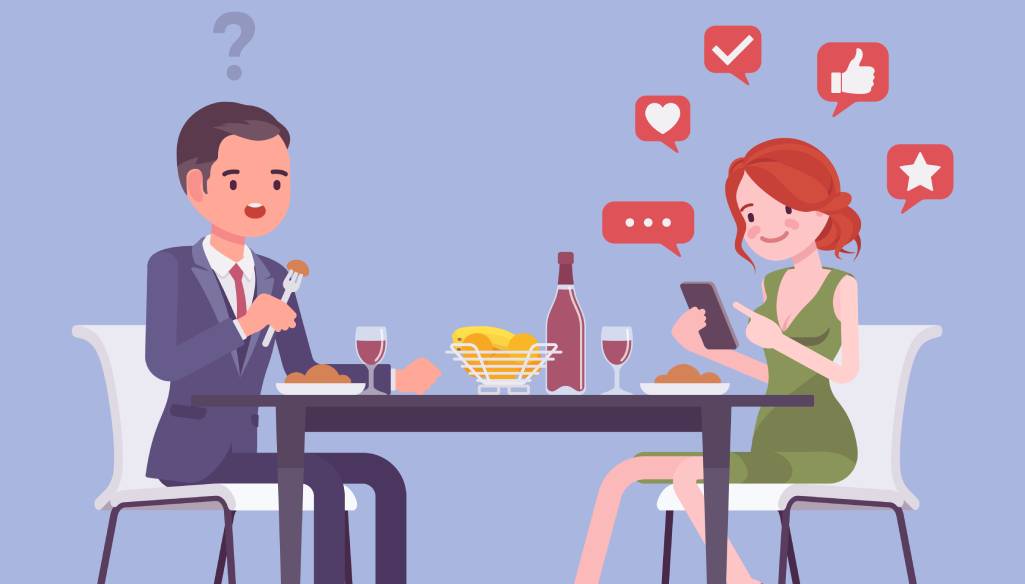
Kamil Driss had been looking forward to this all week. Work had been relentless, the commute had been punishing, and all he had wanted was an evening with Lina Mezioud, just the two of them, unhurried and uncomplicated. He settled into the cushions, reached for his tea, and looked over at her. She was on her phone. Not briefly, not glancingly, but fully scrolling with the focused absorption of someone reading breaking news, occasionally making a small sound that was half-laugh, half-exhale, occasionally tilting the screen toward him to show him something before he had quite processed what he was looking at, and then pulling it back before he could respond. He smiled anyway. He waited. He drank his tea. The playlist played softly to no one in particular.

By 10 p.m., Kamil had said fewer than forty words. Not because Lina was being unkind but because the evening had been quietly, thoroughly colonised by something neither of them had formally invited. Her feed. Her reels. Her comments section. Her online world, populated by people Kamil had never met, having conversations he was not part of, generating reactions in the woman he loved that were louder and quicker than anything he seemed to be producing simply by being there, in person, in real life, on a Friday night.
He didn't raise it that evening. He went home a little quiet, told himself he was being too sensitive, and spent the next three weeks paying closer attention than he had before. What he saw confirmed something he hadn't wanted to name: social media had become the third person in their relationship, present at every meal, every quiet evening, every moment that was supposed to belong only to them. And unlike most third parties, this one had been invited in so gradually that neither of them had noticed the door opening.
1. It Arrives Like a Guest and Stays Like a Roommate
The most important thing to understand about social media's role in modern relationships is that it doesn't announce itself as a problem. It arrives as entertainment, as connection, as the completely reasonable desire to stay informed and engaged with the world, and those things are all genuinely true. Nobody downloads Instagram intending for it to quietly displace their partner. But the technology is designed to expand, to fill available time and attention, to make itself feel essential. And because it arrives gently, dressed as something harmless, most couples don't recognise what's happening until the pattern is already deeply embedded. By the time Kamil was paying conscious attention, the habit was already months old. The guest had unpacked. The guest was not leaving.
2. Emotional Energy Has a Daily Limit — And the Feed Is Spending It
Lina was not a disengaged partner. She was warm, thoughtful, genuinely invested in the relationship, and entirely unaware that she was doing anything that needed examining. But here is a truth about human energy that social media quietly exploits: we each have a finite daily reserve of emotional engagement of curiosity, laughter, responsiveness, presence, and every laugh that goes to a reel, every emotional reaction that goes to a comment thread, every opinion that gets formed in response to something on a feed, is energy that is no longer available for the person sitting in the same room. This is not a character flaw. It is simple human arithmetic. And when the feed is consuming several hours of a person's peak emotional availability, there is genuinely less left over for the relationship. Not because the love has changed, but because the energy has already been spent.
3. Intimacy Requires Unshared Attention That's Becoming Rare
There is a specific quality of attention that makes people feel truly loved, and it is not complicated to describe: it is the experience of someone choosing to focus on you, specifically, in a moment when they could be focused on anything else. That quality of attention is the foundation of intimacy; the feeling that you matter, that you are seen, that this relationship is a place where you are someone's first choice. Social media erodes it incrementally by consistently being the thing that gets the focus first, the thing that captures the eyes before you do, the thing that holds attention longer than the person beside you. After enough of those moments, the erosion becomes the landscape. And people start to feel, in a way they cannot always articulate, that they are background in a relationship where they expected to be foreground.
4. You Start Performing for Who Isn't Your Partner
This one is subtle but deeply worth examining. When Lina posted a photo of their dinner one evening, Kamil noticed something he couldn't quite name at the time. The most elaborate version of their evening had gone to strangers. The composed, curated, publicly presentable version of their time together had been offered to four hundred followers, while the actual, unfiltered, imperfect experience of being together remained between just the two of them. Over time, this creates a strange inversion in relationships: partners begin to unconsciously design shared moments for external approval, and the relationship itself starts to feel like the backstage area — the messy, unedited space behind the content. Real intimacy happens backstage. But when backstage starts to feel less real than the performance, something has shifted in a direction worth paying attention to.
5. Other People's Relationship Content Is Quietly Rewriting Your Expectations
Lina's feed was full of couples on trips, couples in matching outfits, couples surprising each other with grand gestures, couples posting anniversary tributes that read like wedding vows. None of this was real in the way a Tuesday evening in Algiers is real, but it was presented with enough confidence and production value to feel aspirational. And aspiration, when it's aimed at real relationships, is a quietly corrosive thing. Not because wanting good things for your relationship is wrong, but because a feed full of highlight reels calibrates your sense of what is normal in ways you don't always notice. You start to feel, without consciously deciding to, that the ordinary texture of real love is somehow insufficient. The bar moves. And the relationship, which has not changed, suddenly starts to feel like it's falling short of something.
6. The Fights You're Having Might Not Be About What You Think
Kamil and Lina's first real argument was about plans; specifically, a weekend trip that Lina had been wanting to take, which she had first seen on a travel creator's page, and which had been living in her imagination in a polished, aspirational form that the actual logistics could not quite match. The argument was ostensibly about budget and timing, but underneath it was something more tender: a gap between an experience she had been sold by her feed and the reality of what their life together could actually offer right now. Many modern relationship conflicts live in exactly this gap between the curated version of life that social media presents and the imperfect, resource-constrained, beautifully ordinary reality of building something real with another person. Naming the actual source of the tension is the first step to resolving it honestly.
7. Your Partner Cannot Compete With the Internet, And Shouldn't Have To
This is perhaps the most important reframe available to any couple navigating this dynamic: your partner is not supposed to be as entertaining as a carefully engineered content platform. They are not supposed to be as funny as a professional comedian with a writing team, as inspiring as a motivational creator with a production budget, or as visually compelling as an influencer with a ring light and three hours of editing time. Your partner is a whole, complicated, unedited human being who is doing their best, and the relationship you are building together is not content. It is life. Real life does not come with a soundtrack or a filter, and the moments that will matter most to you in twenty years are almost certainly the ones that would have made terrible posts.
8. Silence Between Two People Is Being Replaced by Noise From Everywhere Els
Kamil said something to a friend over coffee: "I don't think Lina and I have had a quiet moment together in months. There's always something playing, something being watched, something being reacted to. I miss just — sitting with her." The quiet moments between two people are where a relationship breathes. They are where the unexpected conversations happen, where you find out things about each other that don't come up in the busy, scheduled, content-filled parts of life. When every silence is immediately filled with a scroll, those moments never arrive. The relationship loses one of its most essential forms of oxygen.
9. What You Choose to Share Online Shapes What Feels Real Offline
After a long conversation, Lina said something that surprised even her as she said it: "Sometimes I feel like things only feel fully real once I've posted them." She laughed a little as she said it, the slightly uncomfortable laugh of someone recognising something true about themselves that they hadn't intended to reveal. But this is one of the most significant psychological effects of sustained social media use: the gradual outsourcing of meaning to external validation. When an experience only feels complete once it has been shared, liked, and commented on, the primary relationship you are having is no longer with the experience itself but with the audience. This is a quiet but profound displacement, and naming it, as Lina did, is the beginning of reversing it.
The third person in your relationship is the one you keep choosing. Choose wisely.


Comments (0)
Please sign in to join the conversation.
Loading comments...