


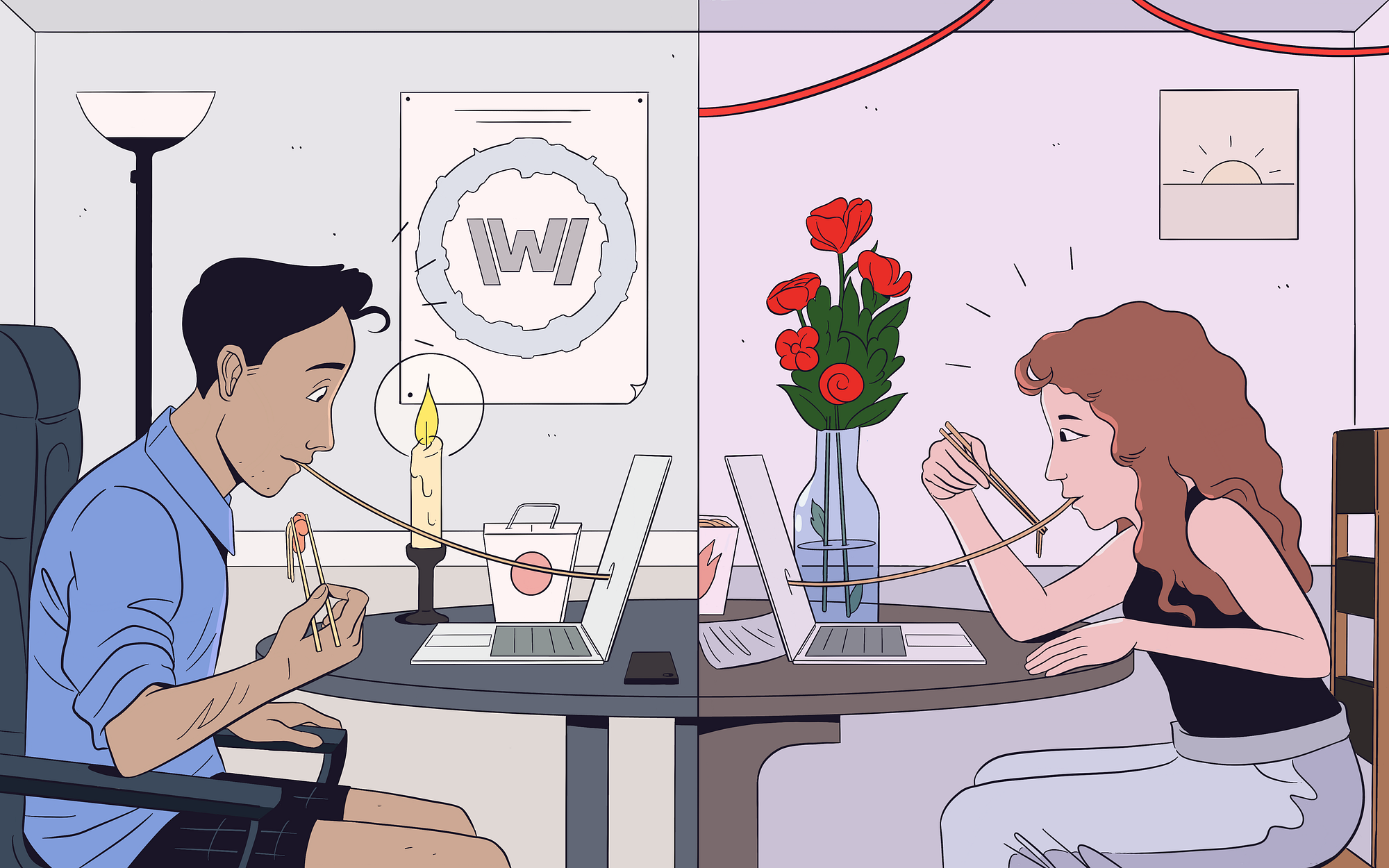
Karim was sitting across from his younger brother Dani at their mother's kitchen table, their mother was in the next room, the smell of harissa and slow-cooked lamb drifting through the air, and Dani had just watched Karim spend four full minutes crafting a caption for a photo he was posting of the two of them together at dinner.

Four minutes. For eleven words.
When Karim finally hit publish, Dani picked up his own phone and scrolled to the post. He watched the likes start coming in, and little red hearts stacking up in real time. Karim glanced at his screen. His posture changed. Something relaxed in his shoulders that Dani hadn't even noticed was tense.
"You checked that faster than you replied to Rania's message this morning," Dani said quietly, not accusing, just observing.
Karim laughed. Then stopped laughing. Then put his phone face down on the table.
This is a conversation for the men who are good at heart but whose expectations of love have been quietly recalibrated by a world that runs on aesthetics, algorithms, and the performance of happiness. This is a flashlight pointed at something most of us feel but haven't had the right words to examine.
The Invisible Renovation of Desire
When you download your first social media app: it doesn't just change how you see the world; it slowly changes what you want from it. The renovation is invisible because it happens so gradually, so pleasantly, so consistently rewarded that by the time it's done, you don't remember what the original room looked like.
Karim grew up watching his parents love each other in the way that first generation did imperfectly, privately, and with a depth that had no audience. His father brought his mother her tea every morning without anyone seeing. His mother stayed up late sewing a button back onto his father's work jacket without posting a reel about it. Their love was not performed. It simply was. And now Karim lives in a world where love that is not documented is somehow suspect, where a relationship that doesn't produce shareable content feels like it might not even be real, and this is not a small thing. This is a fundamental shift in the architecture of intimacy, and it is affecting men in ways that most of us are only beginning to name.
15 Ways Social Media Has Rewired What Men Expect From Love
1. You now expect love to feel like a highlight reel, not a life. Every couple you follow online is posting their best moments of the trip, the anniversary dinner, the spontaneous laugh on the beach. What you never see is the Tuesday evening when nobody feels like talking, the quiet friction of two people figuring out how to share a life. When your own relationship hits those ordinary, unfiltered stretches, your brain misreads normalcy as a problem. It isn't. Ordinariness is not a failure. It is the texture of real love, and it deserves to be recognised as such.
2. You've started measuring your relationship against other people's curated versions. This one is subtle but devastating. When Karim scrolls past a couple looking radiant on a rooftop in Marrakech, something registers. Does he and Rania do things like that? Should they? Would their pictures look like that? The comparison happens before he's even conscious of it. But here's what that couple's photo doesn't show: the argument they had in the taxi getting there, the phone call she took in the middle of dinner, the silence on the flight home. The photo is real. The story it implies is not.
3. Emotional depth has been replaced, in your mind, by visual proof. Love used to be something you felt. Now it is increasingly something you document. And in that subtle substitution, something essential gets lost. When the instinct is to reach for your phone to capture a beautiful moment rather than simply to inhabit it, you are choosing the archive over the experience. The photo becomes the point. The moment becomes the content. And slowly, without meaning to, you start to measure the quality of your relationship by how well it photographs rather than how deeply it moves you.
4. You've absorbed an unrealistic idea of what a partner should look like. This is about the ambient, relentless pressure of imagery that sets an impossible visual standard and then reinforces it a hundred times a day. You're not consciously comparing Rania to anyone. But your brain has been marinating in a particular aesthetic of desirability for years, and that has effects. It creates a low, persistent dissatisfaction that has nothing to do with the actual woman in front of you and everything to do with what the algorithm has been quietly feeding you.
5. You expect love to be constantly exciting. Social media rewards novelty. Every day there is something new; new content, new trends, new drama, new aesthetics. That rhythm rewires your expectation of how life should feel. And then you bring that expectation into your relationship, where the most meaningful moments are often quiet and repetitive — the same morning routine, the same kitchen, the same face you chose. The excitement of sustained love is not loud. It is deep. But you have to slow down enough to feel the difference.
6. Grand gestures have replaced consistent presence in your definition of love. You've seen too many viral proposals, too many extravagant anniversary surprises, too many romantic gestures designed to perform love at scale. And so consistent, quiet presence has started to feel insufficient, both as something you give and something you recognise in a partner. But grand gestures are events. Presence is a relationship. One happens twice a year. The other is every single day.
7. You've lost your tolerance for the natural difficulties of building something together. Relationships require friction, sometimes uncomfortable work of two different people learning to build a life in the same direction. But social media has conditioned you to expect a seamless, aesthetically pleasant experience, and when the friction comes, it registers as a malfunction. Friction is the building material, not the warning signal. The couples who last are the ones who learned to work through it without treating it as evidence that they chose wrong.
8. You've started to perform your relationship rather than live it. Even the most self-aware men do this. You plan the dinner partly because you want to go, and partly because you can already picture the post. You take the photo before you eat. You frame the story for the caption before you've even finished experiencing it. And in that performance, the relationship begins to serve the narrative rather than the other way around. The audience becomes more real than the relationship, and that is a dangerous inversion.
9. You've been trained to move on rather than work through. Social media is a culture of next — next post, next trend, next person, next chapter. When something is hard or boring or stuck, the reflex is to swipe past it. And that reflex, carried into your relationship, makes working through difficulty feel deeply unnatural. Why sit with discomfort and grow through it when the whole world is showing you people who seem to have moved on and found something shinier? What the world isn't showing you is where those people are two years later.
10. Vulnerability has become content rather than connection. There is a version of emotional openness that is genuine, private, and bonding where you tell someone something real about yourself and it draws you closer. And there is a version that performs vulnerability for applause. The therapeutic Instagram caption, the confessional post about growth, the public declaration of what you've "learned." The second version can feel intimate while actually keeping you safe from genuine exposure. Real love requires the first kind, and the culture of performative vulnerability has made it harder to tell them apart.
11. You've started to need external validation to feel that your relationship is real. When Karim checked the likes on that photo, something real happened in his nervous system — a small reward, a sense that the moment had been confirmed as worthwhile. But love that needs outside validation to feel real is love that's lost its centre of gravity. You and your partner are the only audience that matters for your relationship. Everything else is pleasant noise, sometimes, but noise.
12. You've developed a fear of missing out that infects your commitment. Fear Of Missing Out (FOMO) is not just about parties and travel — it extends into relationships. When you scroll past other people's lives looking exciting and full of possibility, something whispers: is this the right choice? Are you living your fullest life? Are you missing something? That whisper is not wisdom. It is anxiety wearing the costume of ambition, and it will follow you into every relationship you ever have until you learn to recognise it for what it is.
13. Your idea of a good partner has become a list rather than a feeling. You've absorbed so many posts about "green flags," "standards," "what you deserve," "non-negotiables," and "red flags" that you now approach potential partners like a checklist audit rather than a genuine human encounter. Rania might check eleven of your fourteen boxes and fail to check three, and suddenly those three feel disqualifying, even though the eleven, if they're the right eleven, could be everything. Love is not a specification document. It is a living thing, and it cannot be fully evaluated on paper.
14. Intimacy has been confused with content. Real intimacy is the quiet, private, unheroic business of knowing someone deeply over time — their fears, their patterns, their particular way of being in the world. But the culture has started to equate intimacy with the willingness to share publicly. He posted about her, so they must be close. She told her followers about it, so it must be real. The inversion is profound. The most intimate relationships are often the least visible, and the most visible are sometimes the loneliest.
15. You've stopped trusting the quietness of a good thing. This is perhaps the most important point. A relationship that is steady, warm, genuinely supportive, and quietly good does not make noise. It doesn't generate content. It doesn't spike your dopamine the way a new match or a viral post does. And so when you're in a genuinely good thing, the absence of drama and novelty can feel, wrongly, like the absence of love. You have to actively retrain yourself to recognise peace as a form of richness rather than a symptom of stagnation.
What You Can Actually Do With This
Start by auditing your own relationship with your phone in the context of your relationship. Not in a self-punishing way, but honestly. Notice when you reach for it. Notice when the impulse to document overtakes the impulse to simply be present. Notice when you catch yourself measuring what you have against what someone else seems to have online, and practice asking, every single time: do I actually know the full story? I don't. Neither do you.
Then do something more important: decide what your relationship is actually for. Not for your timeline, not for your image, not for the quiet social competition of looking like you have it together.

Comments (0)
Please sign in to join the conversation.
Loading comments...