

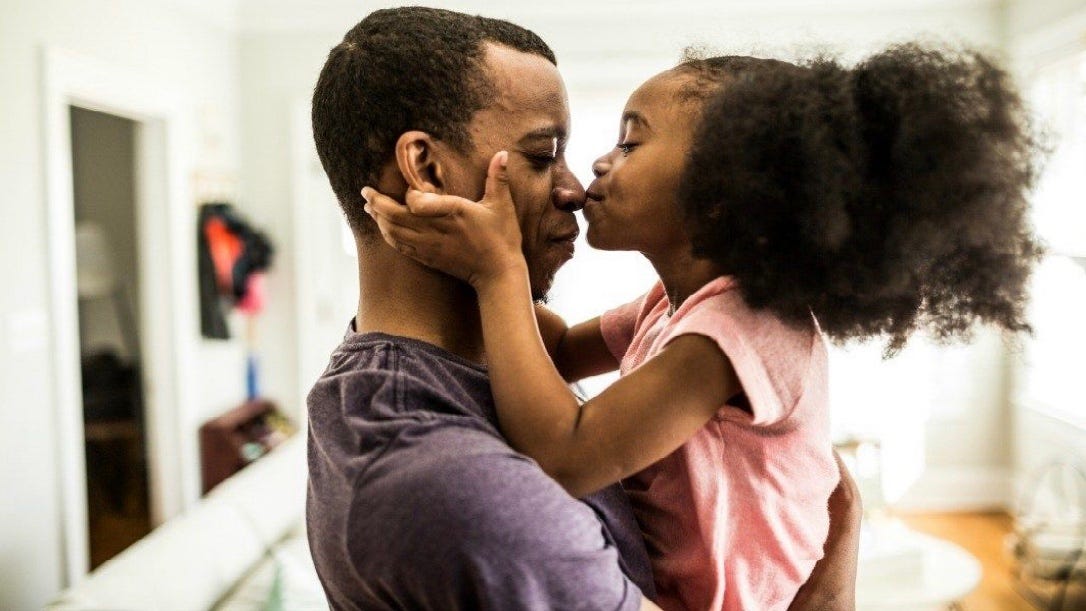
The most powerful things a father passes to his daughter cannot be deposited in an account, tracked in a budget, or purchased anywhere on earth.
The afternoon that changed everything began with a busted tap.
Cabdi Xasan, a civil servant, had spent the better part of a Saturday afternoon underneath the kitchen sink, tools spread across the tiled floor, trying to fix a tap that had been dripping for two weeks.

His 14-year-old daughter Hodan had wandered in, initially looking for a snack, and had ended up crouching beside him on the floor, head tilted sideways, watching with the focused curiosity of someone who had just discovered that the world behind the wall was more interesting than the one in front of it.
Cabdi, without really thinking about it, had handed her the wrench and talked her through what he was doing, where the problem was, why the washer had worn out, how to check the seal before tightening anything back into place.
Forty minutes later, Hodan had fixed the tap herself. Not perfectly but substantively, confidently, with her own hands. When the dripping stopped, and she turned to her father with that expression that sits right between surprise and delight, Cabdi felt something he later struggled to put into words.
"It wasn't the tap," he told me, months later, over a cup of shaah in his sitting room while the afternoon light came through the window in thick, warm strips. "It was watching her realise she could figure out something she had never done before. That look on her face — that's what I want her to carry forever."
That afternoon in the kitchen quietly contained several of the 26 lessons we are about to walk through. None of them cost Cabdi a single shilling. All of them will outlast him.
Before we get into the lessons themselves, fathers and daughters in many homes exist in a strange emotional distance that nobody planned, and nobody particularly wants.
The father works. He provides. He is serious, respected and a little hard to reach. The daughter grows up knowing he loves her, but she does not always know him, and he does not always know how to reach across the gap in a way that doesn't feel awkward for both of them.
That gap is not cruelty. It is mostly habit, inherited from fathers who also kept their distance, who were also taught that provision was the fullest expression of love available to a man.
But the world that Hodan and daughters like her are growing into requires more than provision. It requires a woman who knows her own voice, trusts her own judgment, can solve problems under pressure, and does not need external validation to know she is capable.
And the single most powerful source of that knowledge, for a daughter, is her father.
This is not pressure. It is an invitation. Twenty-six of them, to be precise.
1. Teach her that her voice deserves to be heard. Faarax made a rule in his house early on: at dinner, every person at the table got to finish their sentence. No interrupting, not even when the children were small, and their sentences were long and wandering. Ifrah, now studying law at university, told me that rule is the reason she is not afraid to speak in a room full of people. She learned, at her own dinner table, that what she had to say mattered enough to be finished.
2. Show her how problems get solved, not just that they get solved. This was the tap lesson. When Cabdi fixed things around the house, he started narrating the process to Hodan. Just as conversation. The result was a daughter who knows that a broken thing is an invitation to think, not a reason to panic.
3. Let her see you ask for help. Faarax once asked Safia to proofread an important letter he was sending to a supplier. She was fourteen. He could have asked a colleague. He asked her. What she heard in that request was: your mind is useful. I trust it. She has never forgotten it.
4. Teach her that effort is more reliable than talent. The Saturday mornings Cabdi spent quietly at his desk, working through the paperwork of his job without complaint, taught Hodan that the unglamorous work is what actually moves things forward, and that discipline is just commitment showing up when the excitement has gone.
5. Show her how to handle disappointment without unravelling. When Faarax lost a significant contract two years ago, he did not collapse, and he did not pretend nothing had happened. He sat with his daughters at the kitchen table and said, simply: "This one didn't work out. We'll find another way." That sentence was a masterclass in emotional resilience.
6. Let her make decisions and live with them. Not big, dangerous ones but small ones first. What to cook on Sunday. Which route to take to the market. How to arrange the furniture in her room. The point is the practice of deciding, and the quiet confidence that comes from discovering that your own choices can work out.
7. Teach her the language of money without embarrassment. Cabdi started explaining his household budget to Hodan at thirteen — not in overwhelming detail, but in principle. This is what comes in. This is what we use it for. This is what we save. She now understands money as a tool, not a mystery, and she is not afraid of it.
8. Show her what it looks like to treat people with dignity regardless of their position. How a father speaks to the person who parks his car, to the woman who sells at the roadside, to the junior colleague, is read carefully by daughters, and it becomes the standard against which they measure every relationship they enter.
9. Apologise to her when you get it wrong. When Faarax raised his voice once during an argument with his wife, and Safia witnessed it, he went to Safia's room afterwards and apologised — not for the argument, but for the tone. "That wasn't the right way," he said. "Adults get things wrong too."
10. Tell her she is capable before she proves it. Not after. Before. The vote of confidence that comes before the evidence is the one that creates the evidence.
11. Let her see you read, learn, and grow. A curious father raises a curious daughter.
12. Teach her to negotiate — starting with you. Let her argue respectfully for what she wants, and respond to good arguments when she makes them.
13. Involve her in decisions that affect the family. Not every decision — but some. She needs to know she is a stakeholder, not just a resident.
14. Teach her the value of solitude. A daughter who is comfortable alone will never make desperate decisions just to avoid being by herself.
15. Show her physical strength is not the measure of capability. When Hodan fixed the tap, Cabdi never once suggested it was unusual for a girl. It wasn't, in his house.
16. Tell her what you admire about her — specifically. Not "you're a good girl." Tell her which quality you see and why it matters.
17. Teach her that kindness is not weakness. Model it.
18. Let her fail at something low-stakes and support her through it. The recovery is the lesson.
19. Teach her to cook, not as a gender role, but as a life skill. And cook beside her, so she understands it is everyone's responsibility.
20. Share your own story with her — the whole one, including the hard parts. She needs to know that the adults she admires also came through difficulty.
21. Protect her without isolating her. There is a significant difference, and it is explored in its own conversation.
22. Celebrate her intellectual wins as loudly as her social ones. The way a father responds to a daughter's intelligence tells her everything about how she should value it.
23. Teach her what healthy disagreement looks like. Two people can hold different views and still respect each other — show her this, in real time.
24. Let her see your friendships. Watching a father maintain good, reciprocal friendships teaches a daughter what to look for and what to walk away from.
25. Tell her what you hope for her. Not what you plan. What you hope. The distinction matters.
26. Be consistent. All twenty-five lessons above only land when they are delivered consistently — not as performances on special occasions, but as the ordinary texture of daily life.
Something you build carefully with the person right there beside you holds. long after you're no longer in the room to check on it.
Long after.
