

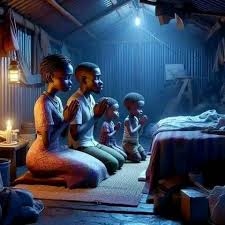
Emeka had been married to Adaeze for 11 years when it happened, Tobenna, looked up from his homework and asked, "Daddy, do you talk to God about us?" The question sat in the air like incense. Emeka opened his mouth and closed it again. He was a deacon in his local church. He led the men's fellowship on alternating Saturdays. He gave generously and served faithfully.

But in that moment, staring into the unfiltered honesty of a seven-year-old's eyes, he realised something had been missing from his home life.
His story is not unique as there are men sitting at the head of tables, providing income, managing logistics, solving problems, and yet somehow still absent from the spiritual heartbeat of their own households.
This is not a rebuke. This is an invitation. Because the truth is, most men were never taught what it actually means to be the husband-pastor of their home.
No one hands you an instruction manual when you walk down that aisle or when the nurse places your child in your arms for the first time. You are expected to figure it out. And most men, being the problem-solvers that they are, default to what they know: provide, protect, and show up physically.
These are noble things. They matter enormously. But they are the floor, not the ceiling, of what your home needs from you.
The idea of being a husband-pastor is rooted in something ancient and profoundly simple. It means that the same intentionality with which a pastor tends to a congregation is the same intentionality God expects you to bring to your marriage and your family.
You are not just a breadwinner. You are a spiritual custodian.
And that role doesn't require a theological degree or a pulpit. It requires presence, humility, and a genuine hunger to honour God inside the four walls of your own home.
It is the atmosphere you create when you walk through the door after a hard day, whether your energy brings peace or tension.
It is the way you speak to your wife when you disagree, choosing gentleness because you actually believe that she is someone God entrusted to your care. It is sitting with your child when they are confused about something and not rushing to fix it, but being present enough to listen.
These are not religious activities in the traditional sense. They are the very texture of a God-honouring home.
One of the most important distinctions a husband-pastor must make is your wife is not a member of your congregation. She is your co-builder, your equal partner in the shared assignment of the home.
The moment a man begins to treat spiritual leadership as a form of authority over his wife rather than a responsibility before God, the atmosphere in that home shifts.
Praying with your wife is different from praying for your wife, though both matter. Praying with her means you are standing together before God as a team, acknowledging that you do not have all the answers, that this life requires more than what either of you can produce alone.
It is the kind of closeness that comes from being genuinely vulnerable before something greater than both of you, together.
Children are extraordinarily perceptive as they do not evaluate your faith by your church attendance record. They evaluate it by how you treat their mother, by whether you apologise when you are wrong, by whether they have ever seen you sit quietly and read your Bible not because you were preparing a speech but because you actually needed it yourself.
What a son watches his father do in private becomes the benchmark by which that son will one day measure himself. What a daughter sees her father extend to her mother becomes the standard she will either seek or settle for.
This is a weight worth carrying consciously.
The culture around men and strength has long told us that leadership means control, that authority means dominance, that a man in charge is a man who has all the answers.
But the husband-pastor framework turns this entirely on its head, and that is precisely what makes it both countercultural and transformative.
The strongest thing you will do as the spiritual head of your home is surrender your ego, your need to be right, the idea that your family's faith journey depends on your perfection.
Honouring God as the foundation of your home does not mean you become a saint overnight.
It means you become honest about where you are and intentional about the direction you are moving.
It means that when you stumble, you do not hide it behind a performance of control. You let your family see a man who falls and gets back up, who asks for forgiveness and gives it freely, who builds not on the shifting ground of personal achievement but on something solid and eternal.



Comments (0)
Please sign in to join the conversation.
Loading comments...