

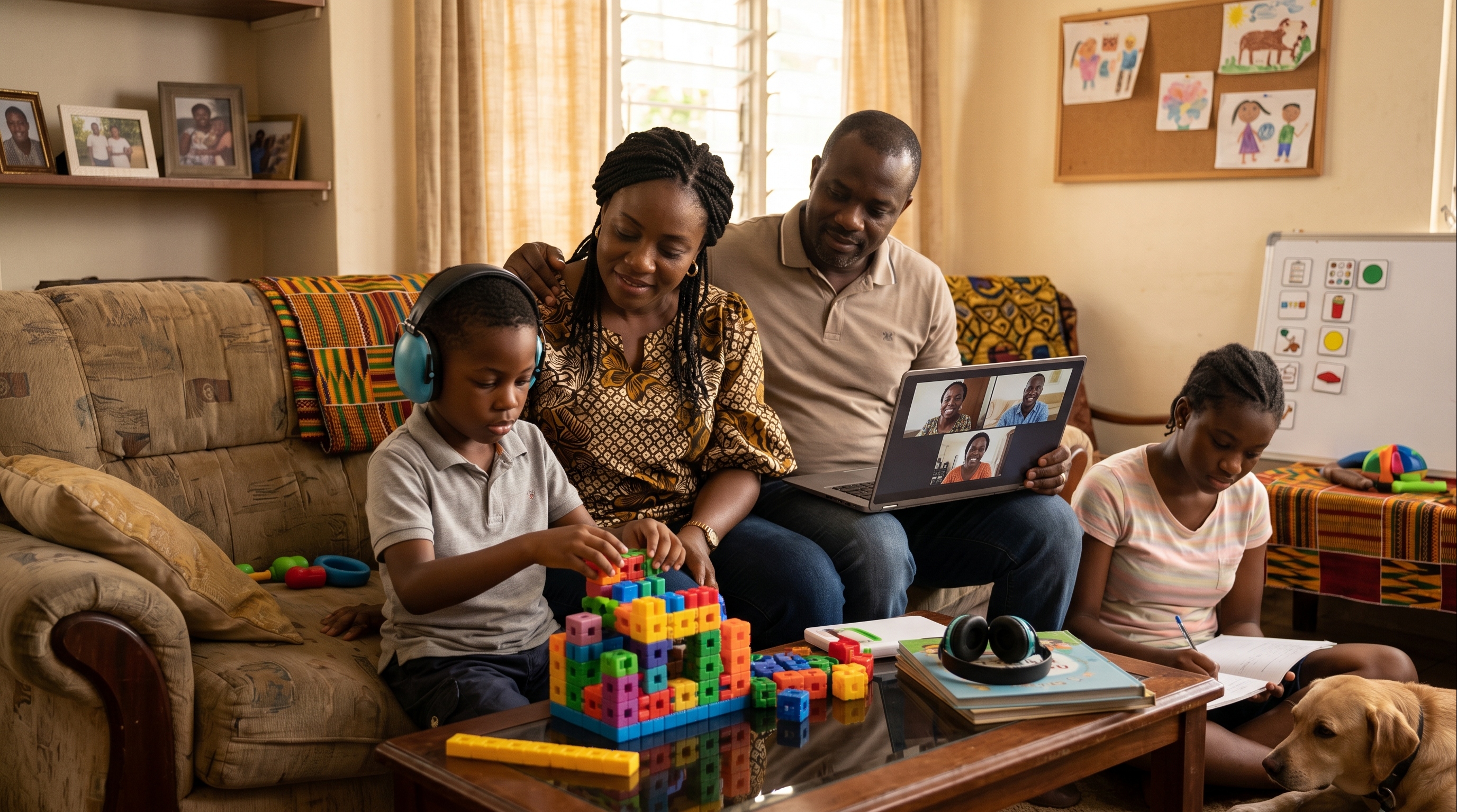
Inside the room, the head teacher and a counselor were finishing a conversation about her son, 14-year-old Kato, whose teachers had described him as "bright but disruptive," a phrase Christine had heard in different forms since he was in primary school. When she was finally called in, the counselor said gently, "We think it might help to have Kato assessed. We've noticed some patterns that suggest he might be on the autism spectrum, possibly with ADHD as well."

Christine sat very still, part of her felt something close to relief, and part of her felt a tightening dread, thinking of every parent-teacher meeting where she'd been told Kato was "not trying hard enough," every birthday party he'd left early overwhelmed by noise, every time she'd quietly wondered if she was failing him in some way she couldn't identify.
She thanked the counselor, took the referral letter, and walked to her car, where she sat for a long time before starting the engine, her mind moving faster than she could keep up with.
Over the following weeks, as Christine moved through the assessment process with Kato, Birungi became something she hadn't expected to need: someone who had walked a similar road and could speak about it plainly What Birungi offered was the kind of knowledge that doesn't come from manuals, but from mothers who have been there, who know the specific weight of certain moments and the specific relief of others.
"The diagnosis doesn't change who Kato is. It just gives you a map for understanding him better—it's not a label that defines him, it's a key that helps explain some doors that have felt locked."
Christine had spent years interpreting Kato's behavior through the lens of discipline and the idea that some of what she'd been responding to as misbehavior was actually his brain processing the world differently began to shift something fundamental in how she saw him, not as a problem to be corrected, but as a person to be understood.
What Birungi explained next was something Christine hadn't anticipated: the grief that often accompanies a diagnosis, even when there's relief attached to it. Christine found herself mourning, in a quiet and confusing way, certain expectations she hadn't realized she'd been holding unto images of how Kato's teenage years and young adulthood might look, ideas about ease that she now understood might unfold differently than she'd imagined.
Birungi told her this grief was normal and didn't mean she loved Kato any less or that his future was diminished; it simply meant she was adjusting her internal map, and that adjustment takes time, the same way any significant shift in understanding does.
As the weeks went on, Christine began noticing things about Kato she'd overlooked for years, because she hadn't had the framework to recognize them as meaningful. The way he needed to know exactly what was happening before transitions because unpredictability genuinely unsettled him.
The way certain textures of clothing or specific background noises seemed to drain his energy faster than they did for Patricia, leaving him irritable in ways that had previously looked, to Christine, like simple bad attitude.
Birungi helped her see these patterns not as flaws to manage, but as information about how Kato experienced the world.
One afternoon, Kato came home from school visibly agitated, and instead of immediately addressing his tone the way she might have before, Christine asked quietly, "Was today loud? Did something feel like too much?" Kato looked at her with an expression she hadn't seen before and said, "The fire alarm went off twice during practice drills, and after that everything felt too bright and too loud for the rest of the day." It was a small exchange, but for Christine, it represented something significant.
Birungi also spoke to Christine about the isolation that often comes with raising a neurodiverse child, particularly in communities where understanding of autism and ADHD is still limited, and where children who behave differently are sometimes seen through the lens of discipline, spiritual explanations, or simple misbehavior, rather than as having different neurological wiring.
Christine had experienced family members who suggested Kato needed "firmer handling," neighbors who looked at her with quiet judgment when he had a meltdown in public, a sense of being alone in trying to understand her own child. Birungi told her, "You're not alone in this, even when it feels that way. There are more of us than you think — we just don't always talk about it until someone else opens the door."
What Christine began to understand was that raising a neurodiverse child requires the need for advocating with schools for understanding rather than punishment, advocating with extended family for patience rather than judgment, and perhaps most importantly, advocating for herself, for her own need for support, information, and rest. This advocacy should be ongoing, woven into school meetings, family gatherings, and everyday interactions, and it can be exhausting in ways that are difficult to explain to people who haven't had to do it.
This is where Christine's own mental health became something she could no longer treat as separate from Kato's needs.
In the weeks following the diagnosis, she noticed herself becoming more anxious, more vigilant, constantly scanning for signs of distress in Kato, constantly preparing for situations that might overwhelm him, while also managing Patricia's needs, her work, and the household.
Birungi, who had been through this herself, recognized the signs and said gently, "Christine, you cannot pour from an empty cup, and there's no shame in needing your own support."
Christine began making small adjustments and small recalibrations that acknowledged her own limits.
She started allowing herself short breaks during particularly demanding days, even if it meant sitting quietly in her room for ten minutes while Kato played a game he found calming. She joined a small group of parents, for not only formal support sessions, but to talk, to share what had worked, what hadn't, and to laugh sometimes about things that would be hard to explain to anyone outside that circle.
One of the most valuable things Birungi shared with Christine was the importance of working with Kato's school not as an adversary, but as a partner, even when that partnership required patience and repeated conversations. Birungi explained how she'd learned to communicate her son's needs clearly to teachers as information that helped teachers understand specific behaviors, like why a sudden change in seating arrangement might cause distress, or why certain instructions needed to be given one step at a time rather than as a long list.
Christine began applying this with Kato's teachers, gradually shifting some of the "disruptive" narrative toward a more accurate understanding of what he needed to thrive.
As months passed, Christine noticed changes not just in Kato becoming a different person, but in the household becoming a place that worked better for who he actually was. Mornings became calmer once Christine started preparing Kato the night before for what to expect the next day, reducing the anxiety that came from uncertainty.
Patricia, too, began to understand her brother differently, no longer interpreting his reactions as simply "Kato being difficult," but recognizing when he needed space or quiet, sometimes even advocating gently for him in small ways, like asking friends to lower their voices when they visited.
Christine came to understand that while those challenges will remain, some days will still be difficult, sometimes deeply so. It's about building a home where Kato's way of experiencing the world is met with understanding rather than constant correction, where his strengths are recognized alongside the areas where he needed support.
For parents walking a similar road, what Christine's experience reflects that the knowledge that makes the biggest difference often doesn't come from books or assessments alone, but from other parents who have lived it, who can translate clinical language into everyday understanding, who can say "this is normal" or "this gets easier" with the authority of experience rather than theory.
Your own wellbeing matters in this journey too, not as an afterthought, but as part of what makes showing up for your child possible, day after day.


Comments (0)
Please sign in to join the conversation.
Loading comments...