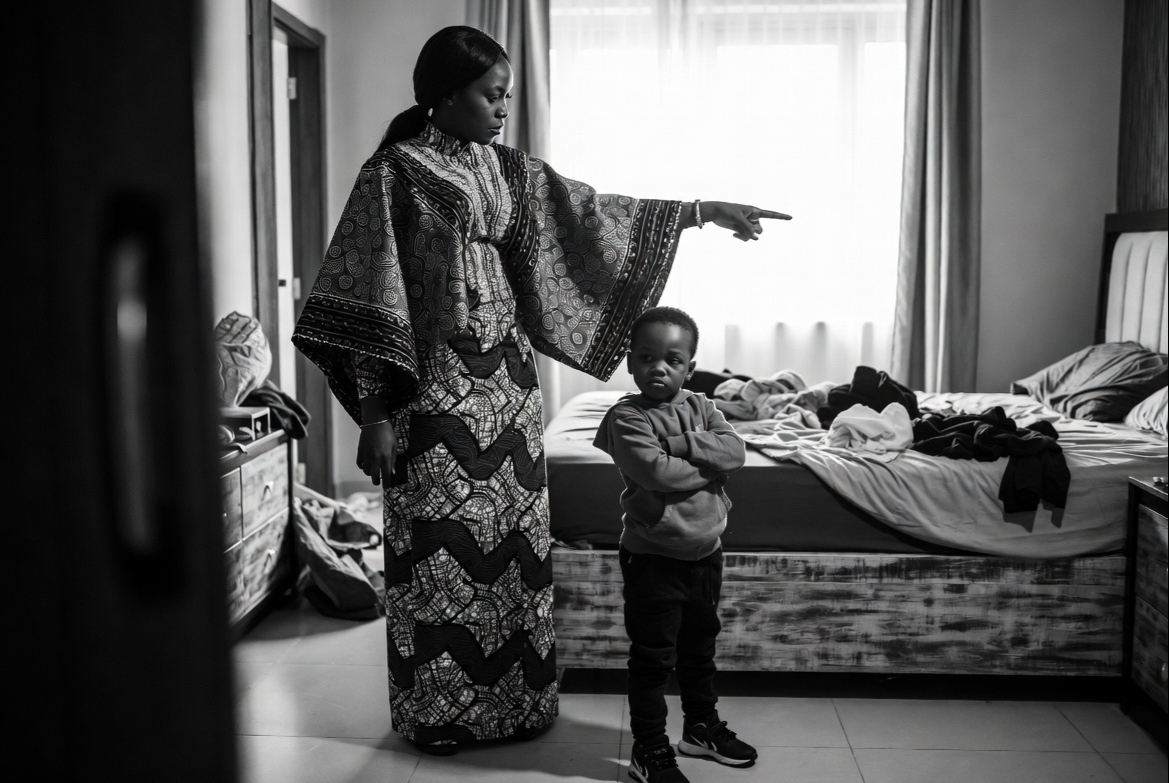

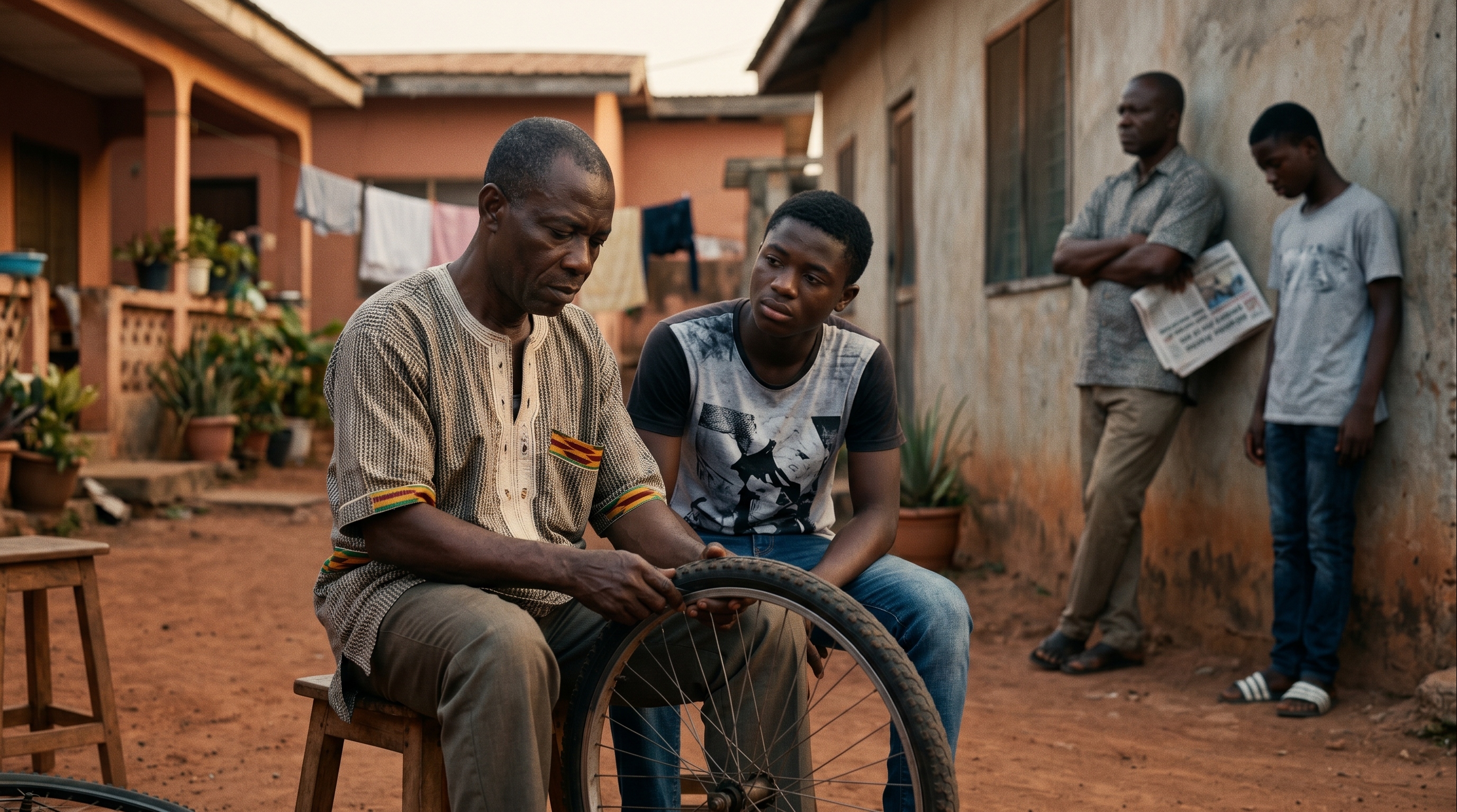
It was a Tuesday evening in Casablanca, when Youssef finally paused long enough to see what had been right in front of him for years. His 15-year-old son, Amine, had failed a mathematics exam and instead of saying anything, the boy had simply walked to his room, shut the door, and gone completely quiet. No words. No argument. No tears. Just silence, thick and practiced, the kind that doesn't come naturally to teenagers but gets learned through watching someone do it for years.
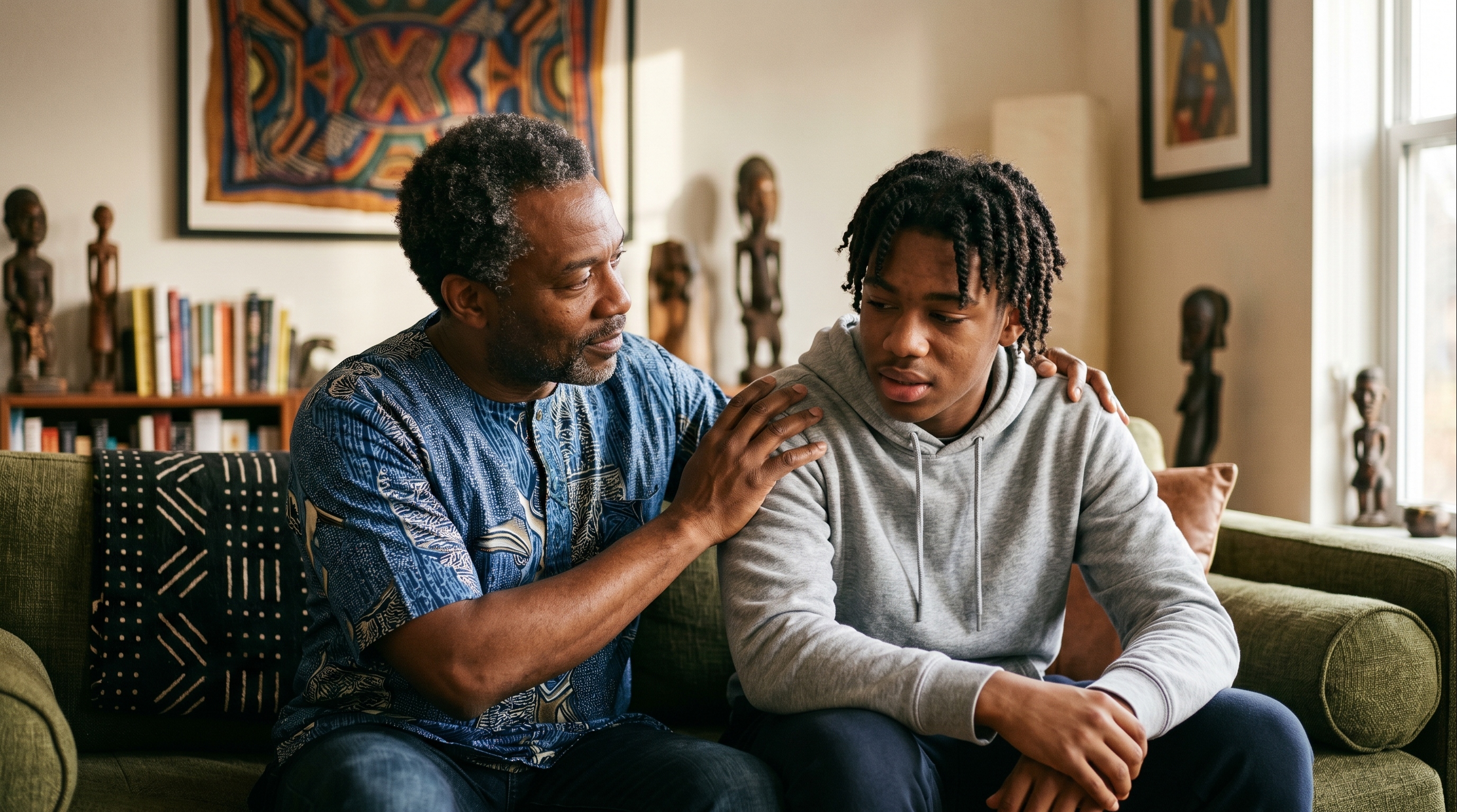
Youssef stood in the hallway outside that closed door for a full three minutes, hand raised to knock, and then he walked away. Because that is what he had always done. Because that is what his own father had taught him without a single lesson: when it hurts, you go quiet. You swallow. You continue. You are a man.
When Brahim died three years ago, Youssef had stood at the graveside dry-eyed while his aunts wept around him, and three neighbours had quietly told him what a "strong man" he was. He had taken that as a compliment. Now, for the first time, he wasn't so sure.
What the 'Stoic Father Myth' Actually Is — And Why It's So Hard to See
Before we go any further, let's name the thing clearly, because it matters. The Stoic Father Myth is not about being calm, disciplined, or emotionally regulated — those are genuinely good qualities. The myth is the specific, quietly inherited belief that a father's primary job is to provide and protect, and that emotions are either weakness, distraction, or simply none of his children's business.
It is the father who is always "fine." The one who handles everything and says nothing. The one who shows love through action alone and considers verbal or emotional expression a kind of softness that the world will punish his sons for if he allows it.
The problem is what his silence teaches, what his unavailability models, and what his sons quietly absorb and carry forward without ever knowing they picked it up.
Youssef Decides to Do Something Different
Three weeks after the closed bedroom door moment, Youssef did something his own father had never done. He knocked. He didn't wait for permission or for the "right time, walked in, sat on the edge of Amine's bed while the boy was doing homework, and said, simply: "Hey. How are you actually doing? Not with school. With life."
Amine looked up from his textbook like Youssef had spoken in a foreign language. There was a long, slightly awkward pause, and then, very slowly, she closed the book. And they talked. Not about everything, not all at once, but enough.
Enough for Youssef to realise that his son had been carrying anxiety about his future, about friendships, about whether he was "enough," and had been carrying it completely alone because "I didn't think you'd want to hear about that stuff, Baba. You always seem like you have bigger things going on."
That sentence. That one sentence.
Youssef drove home from his brother's house later that week and said it out loud to himself in the car, alone on the motorway, and for the first time since his father's funeral, he cried.
Here Are the 22 Ways the Stoic Father Myth Is Costing Our Sons — And What to Do About It
1. It teaches boys that emotional pain is shameful, not human
When a father never shows that he struggles, his son learns by osmosis that these feelings are things to be hidden, not processed. The result? Boys who grow into men who cannot identify their own emotional states, let alone speak them.
2. It disconnects sons from their fathers at the exact moment they need connection most
Adolescence is the developmental window when boys most need a trusted older male to help them make sense of what they're becoming. The stoic father, however well-meaning, is emotionally unavailable at precisely this moment, and the son doesn't grow closer to another mentor. He typically grows closer to peers who are equally lost, or he simply grows inward and alone.
3. It models silence as the default response to difficulty
Youssef's silence outside her door was a pattern, inherited and repeated, because no one had ever interrupted it. Sons who grow up with silent fathers learn that when life is hard, you go quiet. This becomes catastrophic in adult relationships, in workplaces, and most painfully, in their own eventual experience of fatherhood.
4. It creates men who cannot ask for help — even when they are drowning
Men die by suicide at dramatically higher rates than women almost everywhere in the world. A significant contributing factor is the inability or refusal to ask for support, because asking for help was never modelled as a strength. Fathers: when you go to therapy, talk to a trusted friend about a hard season, or simply say "I needed help and I got it," you give your son permission to do the same.
5. It conflates masculinity with endurance, rather than wisdom
Resilience that looks like "I feel nothing and need nothing" is suppression wearing strength's clothes. Real masculine wisdom, the kind that actually serves sons, looks like: I feel this, I name it, I decide what to do with it. That is the version of manhood worth modelling.
6. It makes sons feel like burdens for having emotional needs
Amine said it clearly, "I didn't think you'd want to hear about that stuff." That is the sentence of a child who has correctly read the emotional temperature of his father's house and calibrated his own expression accordingly. When sons do not bring their inner lives to their fathers, it is almost never because they don't want connection. It is because the environment has not made connection feel safe or welcome.
7. It passes down unprocessed grief across generations
Youssef didn't cry at his father's funeral. His father probably didn't cry at his grandfather's. The grief sits in the body, gets compressed, and eventually shows up as rage, distance, chronic tension, or the particular hollowness of a man who has never fully mourned anything. Fathers who grieve openly interrupt a cycle that can run for centuries.
8. It teaches sons to measure their worth entirely through achievement
When love is expressed primarily through provision, sons learn that they are valuable when they perform. This is an exhausting and fragile foundation for self-worth. The boy who fails his maths exam doesn't just need help with trigonometry. He needs to know that his father's love for him is not indexed to his results. Say it. Say it regularly.
9. It makes vulnerability feel dangerous rather than connective
Somewhere, the stoic father mythology picked up the idea that showing vulnerability makes you a target — that the world will exploit softness. And for some men, in some environments, this has been a survival truth. But it becomes a parenting lie when applied uniformly across every relationship, because intimacy is built entirely on the willingness to be real. Sons raised with this fear become adults who cannot sustain deep relationships.
10. It creates a one-dimensional model of manhood that real life cannot sustain
Life will bring every man to his knees at some point. Job loss. Illness. Heartbreak. Death. The man who has only ever been taught to be "solid" has no tools for these moments. He will either collapse spectacularly, numb himself into dangerous patterns, or survive but never heal. Sons need to see a father who is strong and flexible, capable and tender, reliable and human.
11. It robs fathers of their own joy and connection
This point is for you, fathers, directly: the myth doesn't just damage your sons. It impoverishes you. The inability to be emotionally present costs you the relationship with your child that you are actually working so hard to provide for.
12. It makes men physically sicker
This is medical, not metaphorical. Chronic emotional suppression is associated with elevated cortisol levels, weakened immune response, cardiovascular risk, and higher rates of hypertension. Men who cannot express or process emotional distress hold it in their bodies instead. Teaching your son to acknowledge and address emotional pain is, literally, a health intervention.
13. It leaves sons without language for their inner lives
Emotional vocabulary is taught, through exposure and modelling. A father who names his emotions gives his son building blocks for self-awareness. A father who never does leaves his son with a rich and complicated inner world and no words for any of it. This is how men end up saying "I'm fine" when they are anything but, because "fine" is the only tool in the box.
14. It makes sons afraid of their own anger
Here is a paradox: men socialised into stoicism don't actually stop having emotions. The emotions just lose their nuance. What remains is often an undifferentiated mass that surfaces as irritability, impatience, or explosive anger was allowed to stay in the masculine emotional vocabulary. Sons who grow up with emotionally suppressed fathers often develop a complicated, sometimes frightening, relationship with their own rage. Teaching boys to name fear as fear, and sadness as sadness, actually reduces aggression. That is the data. That is also common sense.
15. It positions fathers as service providers rather than people
Youssef's own father, Brahim, was remembered as "solid" and "reliable." But Youssef, three years after Brahim's death, realised he did not actually know his father. Did not know what Brahim feared, what brought him joy beyond his family's success, what he had dreamed of as a young man, what had broken him. Brahim had delivered presence without personhood. And that is a loneliness that sons carry.
16. It makes it harder for sons to be good partners
The ability to communicate about inner experiences, to navigate conflict without shutting down, to be emotionally present with someone you love is built in childhood, through the experience of having them modelled. Sons of stoic fathers disproportionately struggle in intimate partnerships, not because they don't love their partners, but because no one ever showed them what emotionally available love looks like up close.
17. It creates fathers who repeat the cycle without knowing it
Youssef nearly did. He was at the door. He was going to walk away. He almost did, in fact. The only reason he came back was because his wife, Nadia, had sat him down one evening and asked him gently: "When Amine is 40, what do you want him to remember about who you were to him?" That question cracked something open. Every father deserves someone to ask it.
18. It dismisses professional mental health support as weakness
In many communities, therapy carries a stigma or make problems bigger than they are. The stoic father framework reinforces this. But depression is not weakness. Anxiety is not fragility. A man who seeks support for his mental health is doing exactly what strength actually requires: confronting reality and addressing it. Normalising this for your son may be among the most consequential things you ever do.
19. It teaches sons that love is a transaction
I provide. Therefore I love you. That is the grammar of the stoic father's affection. And while provision is real love, it is incomplete as the only language. Sons need to hear it said. They need physical warmth. They need to be asked about their inner world and to have that world received with interest and care. Not because material love doesn't count, but because human beings need more than one dialect of love to feel truly known.
20. It makes mental struggles invisible until they become crises
Men who do not have established habits of emotional expression, self-reflection, or help-seeking do not gradually deteriorate in visible ways. They manage, and manage, and manage, and then they break, often suddenly, in ways that seem to come from nowhere but have been building for years. Your son, watching you manage everything in silence, is learning that this is the only way. The cost of that lesson compounds across decades.
21. It denies sons the gift of a father who is fully human
There is an unexpected gift in a father who says: "I got that wrong and I'm sorry," or "I've been struggling with this and I'm figuring it out," or "I love you and I don't say it enough." The gift is permission to be imperfect, to grow, to be both strong and tender without contradiction. This is the father sons carry with them for the rest of their lives. Not the one who never showed cracks, but the one who showed them what it looks like to acknowledge the cracks and keep building anyway.
22. It costs us the version of our sons they were always capable of becoming
This is the real headline. Not the myth itself, but what it prevents. There is a version of Amine, who can only emerge if Youssef chooses, again and again, to knock on that door. To show up not just as provider but as person. To say: this is how I feel, this is what I'm working through, this is who I am, and you are safe to do the same. That version of Amine is not a fantasy. He is already there, waiting behind a door that only a father can open.