


There's a moment that happens in almost every household with a teenage girl in it, and it usually happens at the worst possible time. Maybe it's 11pm and the dishes still need washing. Maybe it's in the car, on the way to a cousin's engagement party, both of you dressed up and running late. The daughter says something small, almost like she's testing the water with her toe. And the mother, tired, distracted, juggling six other things in her head, answers quickly without really hearing what was just asked. The moment closes. Nobody notices it closing. But it closes, and it doesn't always reopen.
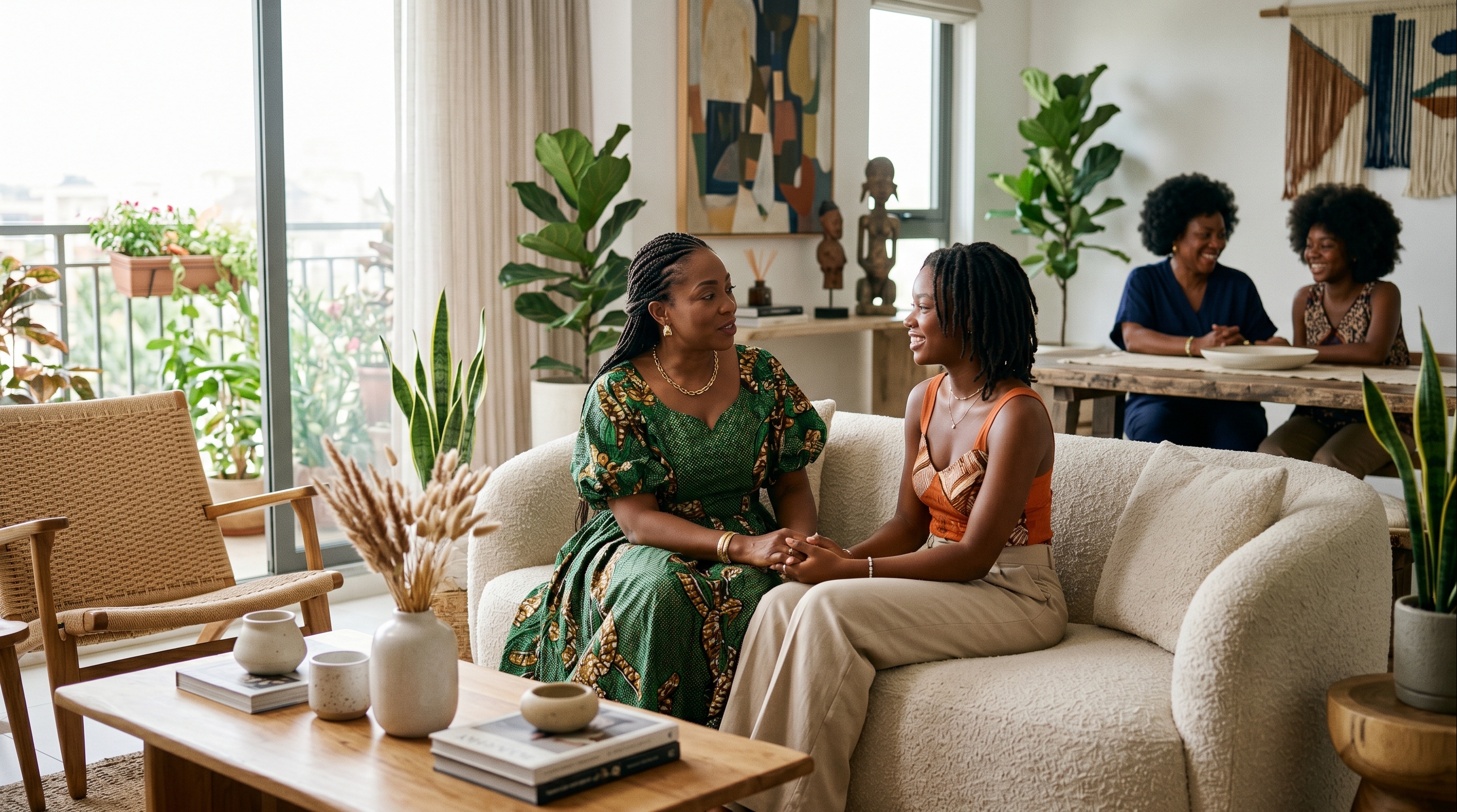
This is a story about three of those moments, three different homes, three different girls, and what happens when the moment is allowed to stay open instead.
Yasmine, the Almost-Conversation in the Kitchen
Yasmine was 16, the second of four children in a family in Fez, and she had a habit her mother Khadija found endearing for years before she understood what it actually meant. She would hover. She'd find a reason to be in the kitchen while Khadija, her mother, cooked, peeling something nobody asked her to peel, rearranging spice jars that didn't need rearranging. Khadija used to think her daughter just liked company. It took her a long time to realize her daughter was waiting for an opening, a pause long enough to say the thing she actually came to say.
One evening, while Khadija stirred a pot of harira, her daughter finally said it. "Mama, how do you know if a boy actually likes you, or if he's just being nice because everyone's watching?" Khadija's first instinct, the instinct most of us would have, was to deflect. Laugh it off. Say something like "you're too young to worry about boys" and change the subject to homework.
She felt the words forming. But she caught herself, because she remembered being fifteen and asking her own mother something similar, and getting silence instead of an answer, and how that silence taught her nothing except that this topic was off-limits forever.
So instead, Khadija turned the stove down, which is a small gesture but it told Yasmine something important: this matters enough to pause for. She didn't have a perfect answer. She said honestly that she still wasn't always sure herself, even as a grown woman, but that the difference usually showed up in consistency rather than charm.
A boy who is kind in front of an audience and dismissive when no one's watching is showing you his real character in the second version, not the first. That single idea, that attention without an audience is the real test, stayed with Yasmine for years afterward, long past whichever boy had prompted the question in the first place.
The question your daughter asks you is rarely the only question she's asking. Underneath "how do I know if he likes me" is usually a bigger question: "how do I know if I'm worth liking?" If you only answer the surface question, you miss the chance to address the real one.
To the Daughters Reading This Right Now
You are not being dramatic, and you are not asking for too much. Wanting your mother to talk to you honestly makes you someone who is trying to learn how to be loved well before you go out into the world and meet people who may or may not know how to love you well.
And if the moment hasn't opened yet in your house, if your mother changes the subject or laughs it off or simply doesn't know how to start, you are allowed to be the one who opens it. You can say plainly, "Mama, can we talk about something, I don't want a lecture, I just want to understand."
Most mothers are not avoiding these conversations because they don't care. They're avoiding them because nobody ever showed them how to have them either.
Salma, the Daughter Who Stopped Asking
Not every story has a kitchen-stove moment. Salma's story, from a family in Casablanca, is a little harder to sit with, because it shows what happens when the window closes and stays closed.
Salma was 14 when she first tried to talk to her mother, Naima, about a friendship that had turned uncomfortable, a boy in her class who wouldn't stop messaging her even after she'd asked him to.
Naima, overwhelmed with work and an ailing parent at the time, responded the way exhausted parents sometimes do: "Just ignore him, it's not a big deal, focus on your studies." It was meant kindly. It was not received that way. Salma heard, "this isn't important enough for me to engage with," and she filed that away.
By 16, Salma had stopped bringing things to her mother altogether. Not out of anger, exactly, more out of a quiet conclusion she'd drawn: that her mother's love was real but her mother's attention had limits, and relationship questions fell outside those limits.
She started taking her questions to a friend group chat instead, where the advice was confident, frequent, and often wrong. By the time Naima realized her daughter had a serious crush situation going on, an older boy from another school who Salma had been quietly seeing without telling anyone, she had to learn about it secondhand, from another mother, at a wedding.
Naima wasn't a bad mother. She was a tired one, in a moment that felt small to her and felt enormous to her daughter.
What These Conversations Are Actually About
Strip away the specific situations, the boys, the friend groups, the group chats, and you'll find that almost every conversation a teenage daughter is desperate to have with her mother falls into one of a few categories, and they're worth naming plainly so nobody mistakes them for something smaller than they are.
She wants to know what healthy attention feels like, because she has no other reliable reference point. Television, social media, and friend groups offer plenty of loud examples, but loud isn't the same as healthy, and a teenager genuinely cannot always tell the difference without help.
This is not a failure of her intelligence. It's a gap in her experience, and a mother who has lived through both healthy and unhealthy attention is one of the only people positioned to translate that for her, in plain, unembarrassed language.
She wants to know that her changing body, her changing moods, the unfamiliar pull she feels toward certain people, none of it makes her strange or excessive.
Teenage girls frequently carry private shame about completely normal developmental stages simply because nobody told them what was normal in advance. A short, calm conversation that arrives before the confusion does is worth more than a long one that arrives after the damage is done.
She wants permission to have goals that exist independently of any relationship. This one matters enormously and gets overlooked constantly.
A girl who grows up believing her value is tied to whether someone finds her likeable will chase likeability over almost everything else, including her own ambitions, her own studies, her own physical and mental wellbeing.
Mothers who say plainly, "your worth doesn't go up when a boy notices you and it doesn't go down when one doesn't, your worth was already settled before any of that," are giving their daughters something that protects them for life, long after any specific boy or friendship has been forgotten.
She wants to see that disagreement and conflict don't have to mean abandonment.
Many of the unhealthy relationship patterns that show up later in adult life trace back to a teenager who never saw an example of two people disagreeing and staying connected anyway. If conflict at home always meant withdrawal, silence, or punishment, she will likely either avoid all conflict in her future relationships, swallowing her own needs to keep the peace, or she'll assume conflict always means the end of something, and panic accordingly.
Houda, the Mother Who Started Late and Still Made It Count
The last story is perhaps the most hopeful, because it proves these conversations are never permanently out of reach, even when they start later than anyone would have liked.
Houda, a mother in Rabat, didn't have an easy relationship with her daughter Imane for most of Imane's teenage years. They argued constantly, mostly about small things that were really stand-ins for bigger unspoken frustrations. Houda assumed, as many parents do, that the silence and the arguing meant her daughter simply didn't want her involved in that part of her life anymore.
It wasn't until Imane was 18, packing for university, that Houda finally said something she'd been avoiding for years: "I know we don't always talk easily, but I want you to know you can ask me anything about relationships, about boys, about your own feelings, even now, even though I should have said this sooner."
Imane, by her own later account, cried in that moment, not because the conversation was dramatic, but because she'd been waiting for an invitation like that since she was 13 and had genuinely believed it would never come. It wasn't too late. It almost never is. What changed was the future, which opened up considerably the moment the invitation was finally spoken aloud.
A Closing Word to Every Daughter Reading This
None of these mothers said exactly the right thing in exactly the right way. What mattered was whether the door stayed open long enough for the next attempt, and the one after that.
To every daughter reading this, keep asking, in whatever way feels safe to you, because the question you're carrying is too important to let it waste away unspoken.
And to every mother reading this, the goal was never to have flawless answers ready. It was simply to stay reachable, conversation after conversation, until reachable becomes the thing your daughter trusts about you most.


Comments (0)
Please sign in to join the conversation.
Loading comments...