

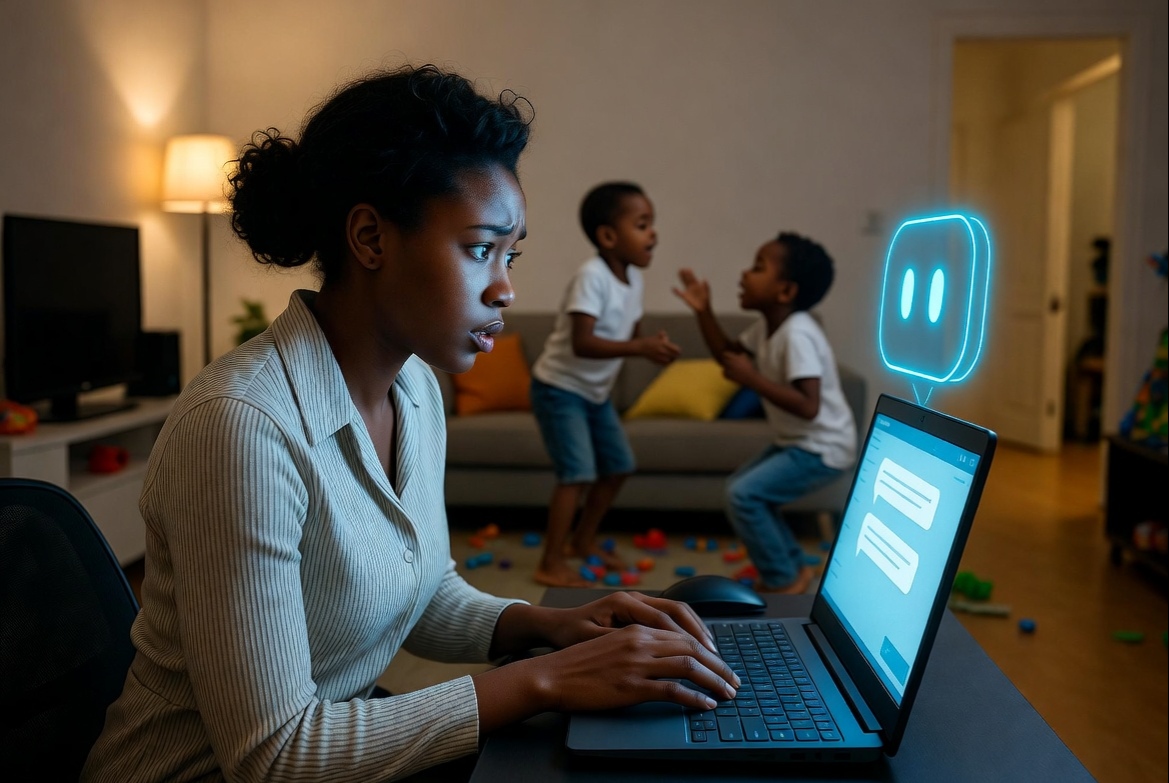
There is something both understandable and deeply worrying about the rise of AI parenting coaches. Understandable, because parenting is hard. Genuinely, earth-shatteringly hard.

In a world where grandparents might live hundreds of miles away, health visitors are stretched thin, and the cost of professional support is out of reach for most families, any voice that offers calm, considered advice at 2 in the morning can feel like a lifeline.
Worrying, because that voice, however warm and reassuring it sounds, does not know your child.
The Effect of Serious Academic Pressure on Your Children
Over the past few years, a wave of apps and AI-powered chat tools have positioned themselves as digital parenting coaches. They answer questions about sleep schedules, tantrums, screen time, nutrition, and emotional development. Some of them are polished, thoughtful, and genuinely useful in the way that a well-written book is useful. But a book doesn't pretend to know your child. It doesn't feel like a trusted person speaking directly to you. AI does, and that is where the trouble starts.
The Illusion of Personalised Advice
When an AI responds to your specific question like, "My three-year-old has been hitting at nursery, what do I do?", it creates the impression of tailored guidance. It mirrors your concern back to you. It uses language that sounds caring and informed.
However, what it is actually doing is generating a statistically likely response based on patterns in a vast training dataset. It does not know whether your child is neurodivergent, whether there has been a recent upheaval at home, whether hitting started after a new sibling arrived, or whether your child is, frankly, just going through a phase that a good night's sleep might sort out.
The danger isn't that AI gives wrong answers; sometimes it gives very good ones. The danger is that it sounds right even when it isn't, and exhausted, time-pressed parents may not have the headspace to question it.
Eroding Trust in Parental Instinct
One of the quieter harms here is what happens to parental confidence over time. When you repeatedly outsource your instincts to an algorithm, something shifts. The natural, hard-won knowledge that comes from living with your child, such as reading their moods, understanding their rhythms, learning their particular version of "tired" or "frightened" or "coming down with something," starts to feel less reliable than whatever the app says.
This isn't hypothetical. It is already evident in how people relate to health information online. Parents who spend hours searching symptoms often come away more anxious, not less. AI parenting tools carry a similar risk: they can amplify self-doubt rather than reduce it, particularly in parents who are already prone to anxiety or who lack a strong support network around them.
The Protection Blind Spot
Here is a concern that rarely makes it into the marketing materials. AI parenting coaches are, in most cases, unregulated. They are not bound by the same safeguarding frameworks as a health visitor, paediatrician, or family therapist. They cannot flag concern. They cannot escalate.
So, if you describe a situation that hints at something more serious, such as child distress, possible abuse, or undiagnosed developmental conditions, an AI tool is not equipped to respond in the way a trained professional must and will.
There is also the question of data. When a parent types their most vulnerable concerns into an app, like their child's behavioural struggles, their own mental health, or their family difficulties, where does that information go? Who holds it, and for how long? The terms and conditions of most parenting apps are not light reading, and most users never look at them.
When Connection Is Replaced By Convenience
Perhaps the deepest harm is this: parenting, at its core, is relational. The whole project of raising a child is about building a connection. First, with your child, and then, with the wider community around you both. Grandparents, friends, health professionals, teachers, and other parents all play a part in that. There is something lost when you begin to substitute those human connections for a chatbot, however clever that chatbot might be.
The loneliness of modern parenting is real and serious. AI cannot fix it. It can simulate warmth, offer information, and create the feeling of being heard, but it cannot actually hear you. It cannot sit with you in the difficult moments, hold the complexity of your specific situation, or offer the hard truth that a trusted friend might gently raise.
This is not an argument against using technology in family life, or even against using AI tools occasionally for information. It is an argument against treating them as authorities. Use AI the way you'd use a library, as a starting point, not an ending one. Then talk to your doctor. Call your mum. Ring a friend whose parenting you admire. These conversations are slower and messier, and they are worth far more.
What to Do Instead
If you find yourself turning to an AI coach regularly, it may be worth asking what gap it is filling. Is it information? Is it reassurance? Is it company? Each of those has a better answer than an algorithm.
A family doctor or paediatrician for medical concerns.
A parenting support group, many are free and local, for reassurance and community.
A friend or partner for company.
If you are struggling in ways that go beyond tiredness, a qualified therapist who works with parents can be genuinely life-changing.
None of this is meant to shame any parent who has used an AI parenting tool. In a world that leaves so many parents feeling isolated and unsupported, it is no surprise that we reach for whatever is available. The problem is not the parents. The problem is a system that offers a chatbot where it should be offering a community.


Comments (0)
Please sign in to join the conversation.
Loading comments...