


There is a moment many parents know well — the one where your child looks at you across the dinner table and says, quietly but firmly, "I don't want to go to university." The air goes still. Your mind races. You think about everything you sacrificed, every school fee you paid, every parent-teacher evening you attended in clothes you ironed twice.
You think: What will people say?
Amahoro remembers that moment exactly. She is a mother of three in Bujumbura, Burundi, and when her middle son, Nzeyimana, dropped that sentence at age sixteen, she felt the floor shift beneath her. "I thought I had failed him," she told me, her voice soft but steady.
"In my mind, the path was simple — school, university, office job, stability. That was the dream I held for him since he was born." She folded her hands on the table as she said it, the way mothers do when they are choosing their words carefully, when they are trying to be honest without reopening an old wound.
But here is what Amahoro knows now that she did not know then: the path she imagined for Nzeyimana was incomplete.
The World Has Changed. Our Idea of Success Hasn't Caught Up Yet.
The model of education that most of us grew up with - study hard, pass exams, get a degree, get a job - was designed for a world that is rapidly transforming.
Factories are becoming automated. The gig economy is reshaping how people earn. Young people with practical, hands-on skills are finding that the market is hungry for what they offer, sometimes more so than it is for yet another degree holder sitting in a pile of fresh graduates competing for the same shrinking pool of white-collar positions.
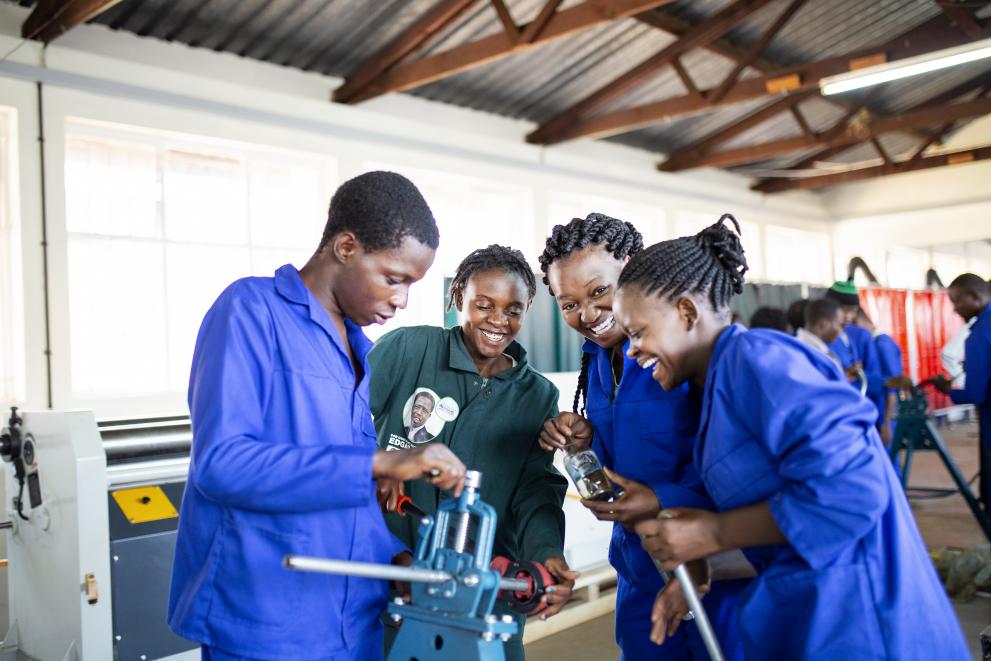
Vocational education, also called technical and vocational education and training, or TVET, refers to structured learning that trains young people in specific trades and practical skills: electrical installation, plumbing, solar panel installation, tailoring and fashion design, automotive mechanics, culinary arts, graphic design, software development, cosmetology, carpentry, welding, and so much more.
These are not "lesser" skills, but skills that keep the lights on, the roads functional, the food on the table, and increasingly, the economy moving.
Vocational graduates are getting employed faster, earning steady incomes sooner, and building businesses earlier than many of their university-educated peers.
Meet Nzeyimana. His Story Is Not an Exception — It Is a Blueprint.
At 16, Nzeyimana was what teachers politely called "disengaged."
He sat in classrooms where he felt invisible, where the curriculum felt like it was speaking a language his hands could not touch. He was simply a young person whose intelligence expressed itself differently — through tinkering, through fixing, through understanding how things worked by taking them apart and putting them back together.
His elder brother, Habimana, who excelled academically, used to tease him gently. "Nzeyimana, you are always dirty with grease," Habimana would laugh, watching him crouch over a broken radio in the courtyard. Nzeyimana would grin without looking up: "At least the radio works now."
It was his uncle, a quiet man who ran a small electronics workshop on the edge of the market, who finally saw what the classroom had missed.
Rucagu invited Nzeyimana to spend weekends at the workshop. No pressure. No grades. Just a young man and a soldering iron and the slow, satisfying education of making broken things whole again.
Within three months, Nzeyimana was diagnosing faults that had stumped Rucagu's older apprentices. Within a year, he had enrolled in a formal vocational training programme for electronics and electrical systems.
At 18, two years after that quiet dinner table confession, Nzeyimana opened a small repair shop. At 19, he hired his first assistant. His mother, Amahoro, stood at the door of his shop on the day it opened and cried out of the particular joy that comes when you realise you almost missed something extraordinary.
What Vocational Education Actually Teaches Your Child
Vocational training does not just teach a skill. It teaches a way of being in the world. When young Zawadi, a 15-year-old girl in the same neighbourhood as Nzeyimana, enrolled in a tailoring and fashion programme at her local vocational centre, she did not just learn to cut fabric and operate a sewing machine.
She learned to read a client's needs. She learned to manage a deadline. She learned to handle failure and to fix it without falling apart. She learned patience, precision, and the quiet pride of producing something with her own hands that someone else would wear with joy.
These are life skills - emotional intelligence, problem-solving, resilience, entrepreneurship - and vocational training embeds them naturally into every project, every task, every client interaction.
By the time Zawadi was 17, she had three regular clients, a small savings account, and a confidence that her teachers marvelled at in the way you marvel at something that has quietly become inevitable.
What You Need to Hear Without Judgment
If your child is struggling academically, it does not mean they are struggling with life. Intelligence is not a single lane. Some children think in circuits. Some think in flavour profiles. Some think in timber grain and joinery angles. The role of a parent is not to force every child through the same door but to find the door that was made for them and hold it open with both hands.
Vocational education offers your child:
a shorter path to income (most programmes run between one and three years), lower training costs compared to university tuition, immediate employability in sectors that are actively hiring, entrepreneurship opportunities that allow young people to create jobs rather than only seek them, relevance to local economies where practical skills are in daily demand, dignity and self-sufficiency that come from mastering something real and useful, a foundation for further learning because many vocational graduates go on to upgrade their qualifications over time, and mental wellness — because young people who are engaged in learning that makes sense to them are less likely to feel lost, idle, or invisible.
Your child is not falling behind. They may simply be walking a road that has not been drawn on your map yet. It is time to draw it.


Comments (0)
Please sign in to join the conversation.
Loading comments...