

There's a moment every parent dreads. You look away for three seconds, just three, and your child has bolted towards a busy road, stuck their finger into a plug socket, or wandered off in a crowded supermarket. Your heart drops. Your legs move before your brain does. Then you think, we need to have a serious chat.

Most parenting books dance around the fact that "serious chat" rarely works. Children don't learn safety through lectures. They learn it through life, through the small, repeated, ordinary moments that happen in your kitchen, your garden, your car, and your living room every single day.
Understanding If Your Child Is Attention-Seeking Or Emotionally Distraught
The good news? Daily family life is absolutely packed with opportunities to raise safety-smart kids. You don't need special sessions or elaborate drills. You just need to be intentional about the moments you're already living through.
Let's get into it.
Why Kids Struggle With Safety Rules
Children, especially young ones, are wired for curiosity, not caution. Their brains are still developing the bit responsible for impulse control and risk assessment. So when your four-year-old runs towards a hot cooker or your seven-year-old leans dangerously over a balcony railing, they're not being naughty. They genuinely don't feel the danger the way you do.
This is precisely why repeating rules to them rarely sticks. "Don't touch that!" works in the moment, but it doesn't build the internal understanding that lasts.
What does work is something called contextual learning. This entails teaching the why behind the rule, in the moment when the rule is actually relevant, and everyday family life hands you these moments on a silver platter.
The Kitchen
The kitchen might be the most hazard-rich room in your home. Sharp knives, boiling water, hot surfaces, slippery floors. But rather than banning your children from it, consider inviting them in with clear, consistent boundaries.
When you're cooking together, talk through what you're doing. "I'm moving the pot handle inward so no one accidentally knocks it off." That one sentence teaches more than a dozen warnings. You're modelling the thought process behind safety, not just the action.
So, the next time you open the oven, say out loud, "Oven mitts on even the door gets hot enough to burn." Let your child hand you the mitts. Let them feel (safely) the warmth from a safe distance. Sensation is a brilliant teacher.
By the time your child is old enough to cook independently, they won't need to remember the rules. The habits already live in their hands.
Road Safety
Most parents teach road safety. But there's a gap between knowing the rules and genuinely understanding traffic. The key is narrating your thinking every time you cross a road together.
"We stop here because cars come fast and sometimes don't see us." "I'm looking right, then left, then right again." "Even though the light says walk, I'm checking because some drivers run red lights."
This running commentary might feel odd at first, but it builds something remarkable. It teaches your child that road safety isn't a rule imposed from outside. It's active thinking that you do every time. That's the mindset you want them to carry into adulthood.
Pedestrian habits, cycle safety, and understanding blind spots on lorries. All of these can all come up naturally during school runs, weekend walks, and trips to the shops.
Water Safety
Drowning is one of the leading causes of accidental death in children, and it is heartbreakingly silent, nothing like the dramatic splashing you see in films. This makes water safety one of the most critical topics to address at home. You don't need to frighten your child. Fear is not the goal, respect is.
When you're at the beach, the pool, or even filling the bath: "We never run near water because wet surfaces are slippery and the water is deep." At a river or canal: "Even if it looks calm, rivers have strong currents underneath that are much more powerful than they look."
Teach your children to swim as early as possible. Make it normal and fun, not scary. Alongside swimming ability, teach them the rules. No swimming alone, no pushing people in, always tell an adult where they're going near water.
If you have a garden pond or paddling pool, supervision rules should be non-negotiable. Make your child know why, not just accept it.
Fire Safety at Home
Every family should have a fire escape plan. But how many children actually know it?
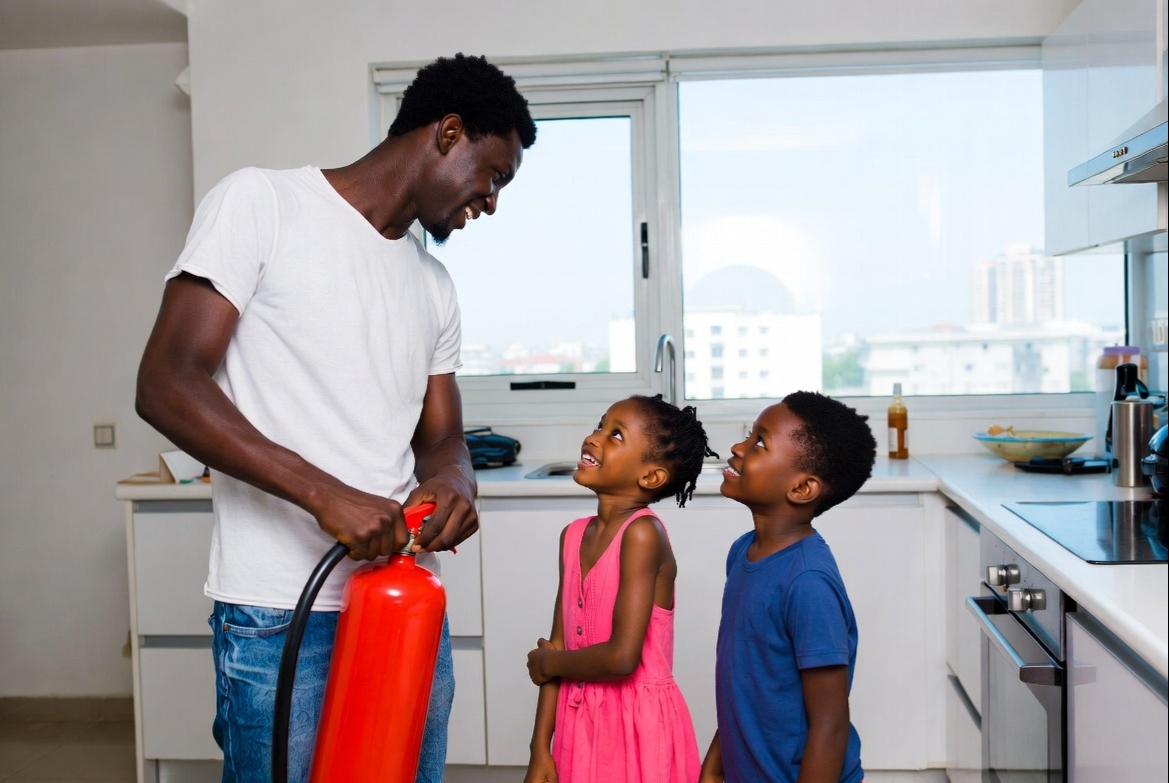
Make fire drills a normal part of home life, not a source of drama. Twice a year, walk through the route together. "If there's smoke, we stay low and get out fast. We don't stop for toys or phones." Practise feeling a closed door before opening it. Show them where to meet outside. Talk about the cooker, candles, matches, and lighters openly. Demystifying these things reduces the forbidden-fruit temptation. "We never leave a candle burning alone because fire spreads in seconds, even when nobody's watching."
Check your smoke alarms together. Make it a ritual. Children who've been involved in that kind of household maintenance are far more likely to take fire safety seriously as they grow.
Online Safety
If your child is old enough to use a tablet, phone, or games console, online safety is no longer optional; it's urgent. Hence, it cannot be a one-time conversation.
The internet changes constantly. What's relevant this year may be different next year. So rather than a big "stranger danger on the internet" talk, weave smaller conversations into daily screen time. "Who sent you that message?" "Do you know that person in real life?" "What would you do if someone online asked you to keep a secret from me?"
Establish open-door policies around devices, not in a controlling way, but in a "we talk about everything in this house" kind of way. Children who know they won't be in trouble for coming to you with something strange or uncomfortable online are far safer than those who feel they have to hide it.
Talk about privacy, passwords, and never sharing personal information. Explain what a scam looks like. Tell them that not everything online is true, and teach them how to question sources.
Stranger Safety
The old "don't talk to strangers" rule is well-intentioned but has real limitations. Most children are harmed by people they know, not strangers. So, telling your child not to talk to any stranger can leave them unable to ask for help when they're genuinely lost.
A more useful approach is to teach trusted adult networks and body autonomy. "If you're ever lost or in trouble, it's safe to ask a shop worker, a police officer, or a mum or dad with children for help." "Your body belongs to you. No one should touch you in a way that makes you feel uncomfortable, and you can always tell me." "If something feels wrong, trust that feeling. You're allowed to say no to adults, even adults you know."
These conversations can happen gently, naturally, and often. They don't need to be heavy or frightening. Keep them matter-of-fact, and your children will absorb them as normal wisdom rather than something alarming.
The Magic of Consistent, Calm Repetition
Here is the secret ingredient that ties all of this together: consistency without drama. Children learn through repetition. The same rule explained the same way, calmly and warmly, over hundreds of daily moments, is worth more than any single serious conversation. When you model safe behaviour without making a production of it, it becomes part of the family culture, just the way things are done here.
Avoid panic reactions when possible. If your child touches something they shouldn't, correct them without screaming. Screaming teaches them to be scared of your reaction, not of the hazard. A calm, clear explanation goes much further.
Also, praise safety-smart choices. When your child remembers to look both ways without being prompted, notice it. "Well done for checking the road, that was really sensible." Positive reinforcement works.
A Need to Consider Age-Appropriate Expectations
Not all safety messages work for all ages. A two-year-old needs simple physical barriers and constant supervision. A five-year-old can begin to understand basic rules. A ten-year-old can handle nuanced conversations about online safety, water currents, and fire escape routes.
Adjust your conversations to what your child can genuinely process, but don't underestimate them. Your children are capable of understanding far more than you give them credit for, especially when you explain things honestly and without talking down to them.
The Ultimate Goal
The ultimate goal isn't a child who follows rules because they've been told to. It's a child who understands why the rules exist and internalises that understanding so deeply that safe behaviour becomes instinct.
That kind of child will make safer choices when you're not there to watch. At a mate's house. On a school trip. Years from now, as a teenager or a young adult facing situations you can't anticipate.
Every small moment in everyday family life is a building block. The bedtime routine, the school run, the weekend in the park. These aren't interruptions to the important work of parenting. They are important work.
So next time you're in the kitchen together, or crossing a road, or running a bath, remember: you're not just getting through the day. You're teaching your child how to navigate a world that won't always be safe, with the confidence and sense to look after themselves.
That's one of the greatest gifts you'll ever give them.